-
Document de presse | 2024.06.18
Olympics: how many days does it take for mosquitoes in Greater Paris to transmit arboviruses, and what preventive measures are needed?
The number of imported cases of dengue in the Greater Paris region increased significantly in the first few months of 2024. In the run-up to the Olympic Games, with huge numbers of international visitors set to come to Paris – especially from endemic dengue countries –, we need to be vigilant. Scientists from the Institut Pasteur, in collaboration with the Regional Mosquito Control Agency (ARD)...
-
News | 2024.06.25
Announcement of the future establishment of the Institut Pasteur du Japon
The Institut Pasteur (Headquarters: Paris, President: Prof. Yasmine Belkaid) is pleased to announce the upcoming establishment of the Institut Pasteur du Japon (IPJ).
-
News | 2024.06.27
Intermittent fasting: cellular cleansing to improve health?
Scientists have reproduced the mechanism of autophagy, stimulated by intermittent fasting. This process enables the breakdown of cellular waste, which has health benefits. But the process naturally becomes less effective as the body ages. Autophagy is a possible avenue for research to "cleanse" neurons of their aggregates of harmful proteins in diseases such as Alzheimer's or Parkinson's....
-
News | 2024.06.29
2024 Pride March: Institut Pasteur committed to diversity and inclusion
Paris, June 29, 2024 – The Institut Pasteur is marking a new milestone today by publicly proclaiming its support for diversity and inclusion. An impressive delegation of nearly 180 Institut Pasteur employees is proudly taking part in the Pride March in Paris, demonstrating a strong commitment to promoting LGBTQIA+ rights and equality for all.
-
News | 2024.07.02
Climate and health: anticipating tomorrow's vector-borne diseases in France
The impact of climate change on the emergence of diseases is well established. This is particularly true of diseases transmitted by blood-feeding insects, of which the tiger mosquito is now a well-known vector in mainland France. The Fondation Crédit Mutuel Alliance Fédérale is working alongside the Institut Pasteur to combat these diseases, as part of its commitment to the public interest and to...
-
News | 2024.07.04
How coronavirus HKU1 forces its way into cells
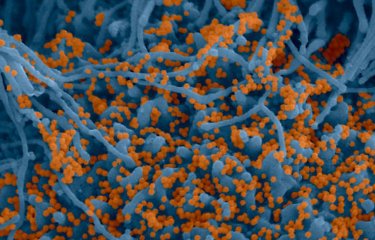
Scientists have pinpointed the precise binding sites for the virus HKU1 in respiratory cells, providing a detailed picture of the infection mechanism used by the virus. Their findings shed light on other animal species that may host the virus and pave the way for the development of infection-blocking antibodies.
-
Portrait | 2024.06.28
Mathieu Picardeau: tackling the trio of water, rats and leptospirosis
Mathieu Picardeau is Head of the Biology of Spirochetes Unit and the National Reference Center for Leptospirosis at the Institut Pasteur. Mathieu is warm, friendly and well-read, with a passion for contemporary art in his free time – but what really gets him excited is a very specific family of bacteria, some of which are fatal for humans. Despite his many responsibilities, he spends time in the...
-
News | 2024.07.04
Instilling a passion for science: the Young Researchers program
The Young Researchers program, developed by the organization Arbre des Connaissances,* offers middle and high school students a unique introduction to research professions. Under the supervision of scientists, the students carry out a research project in the Institut Pasteur's laboratories over several months.Each student pair, composed of one student in the final year of middle school and one in...
-
News | 2024.07.03
A look back at Pasteur Innov' Day 2024 : a hugely successful 2nd edition !
On June 25, 2024, the Institut Pasteur hosted the second edition of Pasteur Innov'Day. The goal was to demonstrate the potential of the Institut Pasteur's research and innovation continuum to industry players in the health sector. The event was attended by almost 150 partners (startups, SMEs, major pharmaceutical corporations, investors, and other innovation stakeholders) as well as many Institut...
-
Report | 2024.07.10
2024 Paris Olympics: the Institut Pasteur supports the health authorities
The Institut Pasteur is working actively alongside health authorities to safeguard public health and safety during the 2024 Olympic and Paralympic Games. It will be introducing several measures and initiatives to respond to the challenge of health surveillance during this critical period.