Evolutionary biology: what an aquatic microorganism can tell us about our distant origins

Try this mental exercise for a moment: imagine what our world looked like 1.2 billion years ago. At that time, all land masses formed a single continent, the atmosphere was oxygen-poor, and there was no terrestrial vegetation. It was during this period that the first multicellular living beings emerged in the ocean, in the form of red algae. Around 500 to 600 million years ago, the most severe ice age on Earth gave way to a warmer planet with higher oxygen levels. The first complex multicellular beings (with cell differentiation, tissue organization, etc.), including animals, emerged.
How did these transitions to simple multicellularity and animal multicellularity occur? Without a DeLorean or time machine to take them back to the past, scientists have to settle for more conventional methods of travel to try to shed light on these questions.
Choanoflagellates, key microorganisms for understanding animal multicellularity
The first metaphorical journey taken by the scientists was an exploration of the tree of life. Based on morphological and molecular criteria, they were able to create a phylogenetic tree, in other words a representation of the relationships between living organisms. This sort of family tree for the living world can be used to trace evolutionary history, showing how organisms are linked by common ancestors. An analysis of the tree shows that the closest relatives of animals are choanoflagellates, aquatic microorganisms that function as single cells or as colonies. The biological proximity of choanoflagellates makes them ideal research models to help us understand the origins of animal multicellularity.
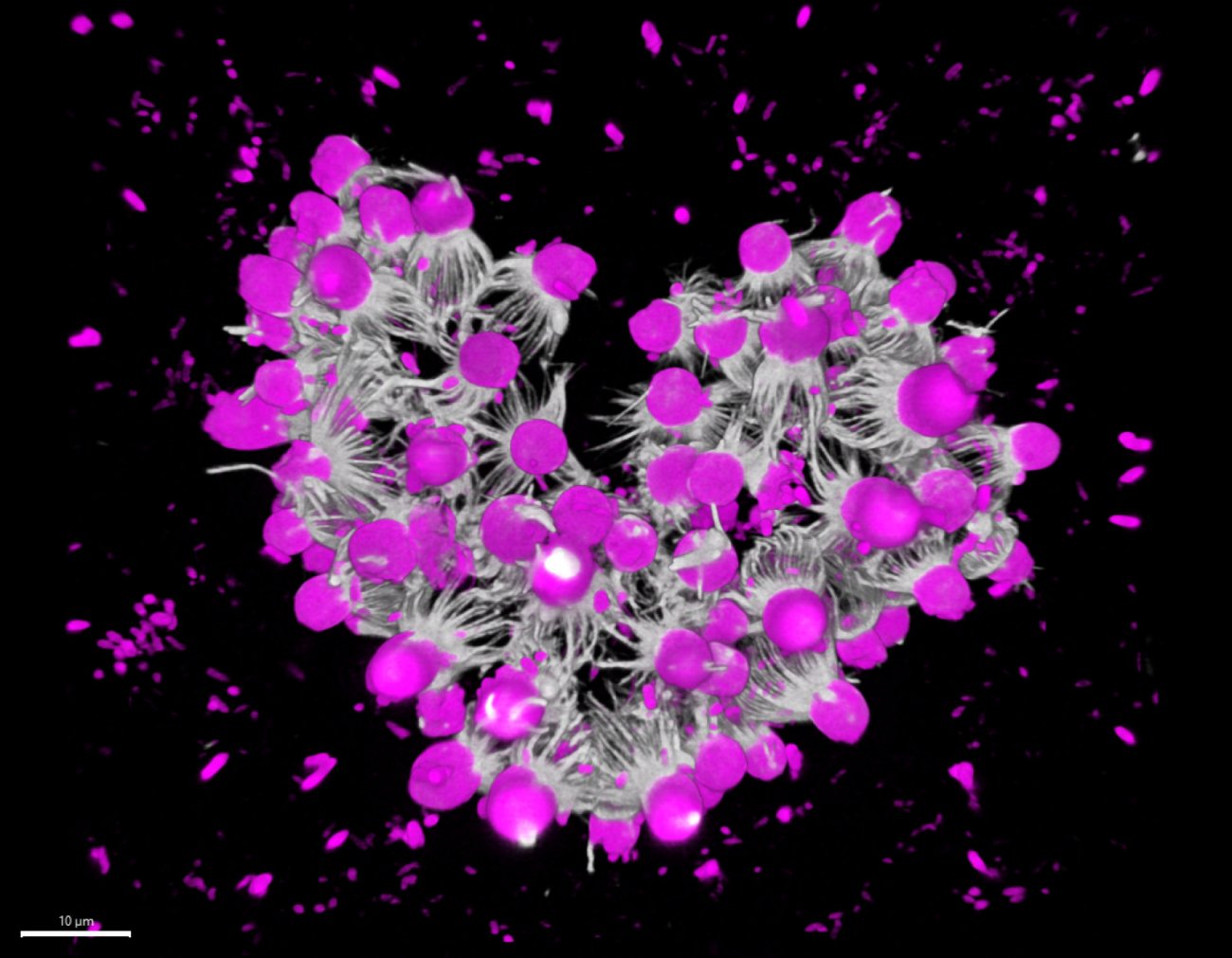
The island of Curaçao, off the coast of Venezuela, was the scene of the scientists' second journey. They were not there for the cocktails or palm trees. It was on Curaçao that a previously unknown choanoflagellate species, Choanoeca flexa (C. flexa), was discovered in 2019. "At the time, we showed that this species exhibited coordinated collective behavior. In response to sudden changes in light intensity, the cells contract, inverting the form of the colony," explains Thibaut Brunet, then a postdoctoral fellow and now Head of the Evolutionary Cell Biology and Evolution of Morphogenesis five-year group at the Institut Pasteur. These initial surprising properties were soon followed by more findings...
The discovery of a new path to multicellularity
In a recently published study, the scientists found that C. flexa forms colonies using a combination of two methods: cell division from a mother cell, and aggregation of isolated cells.
"We previously thought that choanoflagellates could only form colonies through clonal division, when a mother cell divides to form daughter cells – like in an early animal embryo. This mixed multicellularity, which we have described as "clonal-aggregative" multicellularity, was previously totally unknown in these organisms," explains the scientist.
This discovery in the laboratory was particularly surprising, but the scientists were none the wiser as to the reason why choanoflagellates combine these two types of multicellularity and what advantages they might gain in doing so. To understand the phenomenon, they needed to go back to the island of Curaçao and find out more about the choanoflagellate life cycle.
Forms of multicellularity shaped by the environment
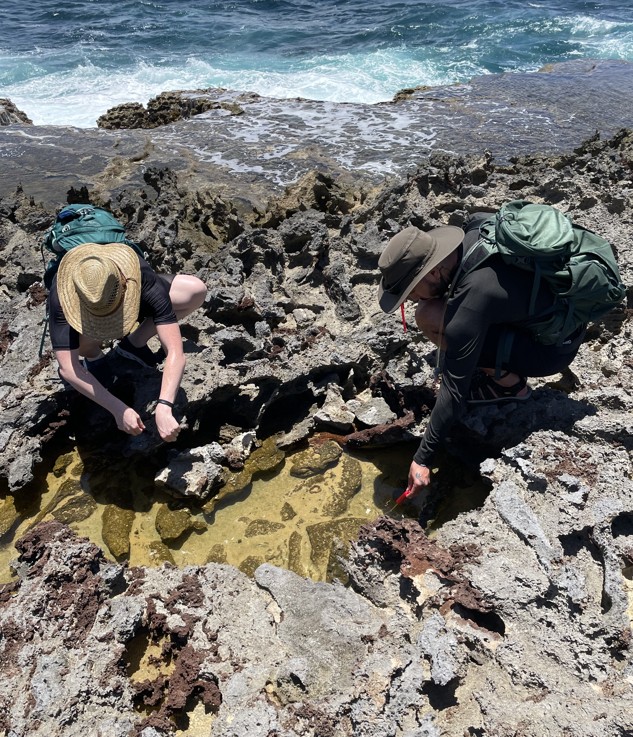
On Curaçao, the microorganism C. flexa develops in a very specific environment. "To put it simply, we sometimes describe it as being akin to the environment in which the extraterrestrials live in The Three-Body Problem [the sci-fi novel by Liu Cixin which was adapted as a TV series] – in other words an unstable, cyclical system." In the case of C. flexa, this environment is formed by splash pools located near the coast, which alternately dry out and fill up again with waves or rainwater. These specific conditions shape the microorganism's organizational forms.
By studying C. flexa in its natural environment, the scientists demonstrated that it is capable of remarkable plasticity: cell colonies form when the pools are filled by waves, separate into single cells when the pools dry up in the heat of the sun, and then form colonies again when the pools fill up with more water. The forms of multicellularity exhibited by the choanoflagellates are also influenced by environmental conditions, especially salinity. In conditions with a low salt concentration and low cell density, clonal multicellularity is the predominant form, whereas if there is a higher concentration of salt, we see more aggregative multicellularity.
Piecing together a more complex evolutionary history?
If we consider the biological stages that led to the emergence of animals as a puzzle, we can say that these discoveries are a key piece, and also that the puzzle may be much larger than originally thought.
"The choanoflagellates that had been studied previously by scientists only form colonies through cell division, much like animal embryos, suggesting a simple, linear scenario. Clonal colonies of organisms resembling choanoflagellates were thought to have resulted in the first ancestors of animals. This scenario is still possible, but it is no longer the only option. What is the evolutionary history between the ancestor of all animals and its ancestor, which is common to both animals and choanoflagellates? This history is probably much more complex than we first thought," explains Thibaut Brunet.
One thing is for sure: from Caribbean islands to laboratory benches, from aquatic microorganisms to genomic analysis, the work to recreate the family tree of our distant ancestors has yet to reveal all its secrets.
Source : Clonal-aggregative multicellularity tuned by salinity in a choanoflagellate, Nature, 25 février 2026
Núria Ros-Rocher1,8, Josean Reyes-Rivera2,5,8, Uzuki Horo1, Chantal Combredet1, Yeganeh Foroughijabbari1, Ben T. Larson2,6, Maxwell C. Coyle2,7, Erik A. T. Houtepen3, Mark J. A. Vermeij3,4, Jacob L. Steenwyk2 & Thibaut Brunet1
1Evolutionary Cell Biology and Evolution of Morphogenesis Unit, Institut Pasteur, Université Paris-Cité, CNRS UMR3691, Paris, France.
2Howard Hughes Medical Institute and the Department of Molecular and Cell Biology, University of California, Berkeley, Berkeley, CA, USA.
3Caribbean Research and Management of Biodiversity foundation (CARMABI), Willemstad, Curaçao.
4Department of Freshwater and Marine Ecology, Institute for Biodiversity and Ecosystem Dynamics, University of Amsterdam, Amsterdam, The Netherlands.
5Present address: Department of Biochemistry and Biophysics, University of California, San Francisco, San Francisco, CA, USA.
6Present address: Department of Biological Sciences and Center for Biotechnology and Interdisciplinary Studies, Rensselaer Polytechnic Institute, Troy, NY, USA.
7Present address: Department of Molecular and Cellular Biology, Harvard University, Cambridge, MA, USA.
8These authors contributed equally: Núria Ros-Rocher, Josean Reyes-Rivera.