

Artificial intelligence: Ai in science, a tool for exploring new frontiers

Accelerating discoveries, unraveling the mechanisms of life, anticipating public health crises, training the researchers of tomorrow, and opening up new therapeutic avenues: these are all challenges that artificial intelligence (AI) is already beginning to turn into tangible results in medical research. From laboratories to classrooms, from computing servers to startups, here we provide an overview of the scientific revolution currently underway at the Institut Pasteur.
Artificial intelligence: a driving force behind a new field of biology
The Pasteur AI initiative, launched in late 2025, aims to make artificial intelligence a driver of biology research. Laurent Essioux runs the project and explains the issues involved: from pathogen modeling to data governance and including the upskilling of research teams.

What is the role of artificial intelligence at the Institut Pasteur?
Laurent Essioux : In late 2025, we launched the Pasteur AI initiative with a clear ambition: to position AI at the center of biology research. It focuses on several levers – internally to help unlock AI’s potential [we already publish many scientific papers every year showcasing research using AI, ed.], and externally to contribute to the development of AI in biology and increase our visibility. Internally, we are recruiting new expertise, upskilling our teams and building an AI-ready data ecosystem. Externally, we are strengthening our academic partnerships – with PR[AI]RIE, Université Paris Cité, Inria and EMBL/EBI – and we are developing industrial collaborations. We aim to leverage AI to attract new talent and philanthropic support.
What does AI actually bring to scientific research?
L. E. : What sets AI apart is its ability to resolve and optimize computational analyses with unprecedented speedand performance. This means we can address biological questions in an innovative way and speed up discoveries. AI also helps us to understand the inherent structure of data (protein sequences, genomes, images, etc.) and to generate new plausible data. It provides a novel toolbox to explore new frontiers. This is illustrated by our flagship project, Ágnes, a digital twin of bacteria (see page 33). The aim of this computational tool is threefold: to predict bacterial phenotypes (characteristics) from their genomes, particularly to predict their antimicrobial resistance or virulence; to generate novel protein sequences with synthetic biology optimizing their properties; and to be searchable by scientists in the manner of a living knowledge base. These three aims – predict, generate, search – illustrate the fundamentally new capabilities that AI can bring to biology.
How is the framework for data management shaping up with the growing importance of AI?
L. E. : Without a sound, structured, accessible data foundation, AI cannot achieve its full potential. This is the challenge of our AI-ready data: investing in our infrastructure, adopting large-scale standardization and improving campus-wide data access, and being able to share it responsibly (according to sensitivity) with our colleagues and the scientific community.
How is the governance of the initiative structured within the Institut Pasteur?
L. E. : We initially adopted an open, collaborative approach to define our strategy. Since then, our actions have been based on existing initiatives or been handled by small groups of people. We laid the groundwork, which included the launch of a joint CNRS/Institut Pasteur call for applications for the position of AI research director, recruitment of a new G5 head with strong AI literacy applied to virology, and recruitment of a head for the new AI division within the Bioinformatics Hub. In addition to these recruitments, we are committed to fostering a collective dynamic by offering lectures on AI for PhD students, reinforcing training, and incorporating AI into our internal callfor- proposal programs. This approach relies on a broadbased engaged community and is crucial for ensuring that AI permeates our entire scientific community.
The key to AI
- Artificial intelligence (AI): a generic term for a range of methods enabling machines to perform complex tasks.
- Machine learning: algorithms using statistical models to make predictions and classifications.
- Deep learning: a machine learning technique using algorithms that are inspired by the human brain to learn from unstructured data.
- Generative AI: an AI category capable of producing new content – text, images, sound, etc. based on trained models. Examples: ChatGPT (Open AI), Claude (Anthropic) and LeChat (Mistral).
- LLM: Large language models (LLMs) are a category of deep learning models trained using vast amounts of data.
- CPU: the computer’s brain that executes routine commands and programs, and processes operations sequentially.
- GPU: originally designed for video games, this graphics processing unit handles thousands of calculations simultaneously and is ideal for training AI and deep learning algorithms.
Leveraging AI to accelerate science
Whether it is used for analysis, correlation or decoding, AI is gaining prominence as a research tool to speed up data processing and expand the scope of what can be achieved. Here, we provide an overview of some of its applications that are already proving beneficial as well as the different types of AI used by the Institut Pasteur.
-
scPRINT: Identifying early markers in precancerous tissues
Trained on over 50 million human and animal cells, scPRINT is the first French AI model capable of predicting gene networks and understanding the mechanisms underlying gene expression. It was developed jointly under the coordination of Laura Cantini’s team and operates like a large language model that is able to run tasks specific to cellular biology, analyzing huge volumes of data and using these to produce detailed representations of cell state. It has already been successfully used to decode novel markers in precancerous prostate tissue.
1. scPRINT: pre-training on 50 million cells allows robust gene network predictions. Nature Communications, vol.16. https://doi.org/10.1038/s41467-025-58699-1
Jérémie Kalfon, co-author of the scPRINT study, explains the discovery. Copyright: Jeanne Fenouil / Institut Pasteur. [Video in French, English subtitles avaiblable]
-
STORIES: Tracking the evolution of cells to unravel the mysteries of disease
Scientists in the Machine Learning for Integrative Genomics team have developed a new method for monitoring cell development without the need for continual observation. Using their approach, it is possible to simultaneously compare a cell’s gene expression and the progression of its spatial position. STORIES is thus able to chart the trajectory and changes in the state of a given cell, shedding light on the influence of environments on cell fate, particularly in the initial stages of diseases.
2. STORIES: learning cell fate landscapes from spatial transcriptomics using optimal transport. Nature Methods, vol. 23. https://doi.org/10.1038/s41592-025-02855-4
-
The fate of bacterial DNA within cells
Scientists at the Spatial Regulation of Genomes Unit joined forces with several collaborators to investigate how a host cell responds when foreign DNA enters its nucleus. Using an AI model developed by the French Natural History Museum (MNHN), they simulated a huge number of scenarios (over 10,000 hypotheses) and thus determined that the composition of the foreign DNA directly influences its fate within the nucleus of the cell it is seeking to enter. Depending on its GC content, it either adapts easily to this new environment or folds into a globular shape within the nuclear space.
3. Sequence-dependent activity and compartmentalization of foreign DNA in a eukaryotic nucleus. Science, vol. 387. https://doi.org/10.1126/science.adm9466
- Read the news article When bacterial DNA invades cells, does it have the code to adapt to its new environment?

Better anticipating pandemics
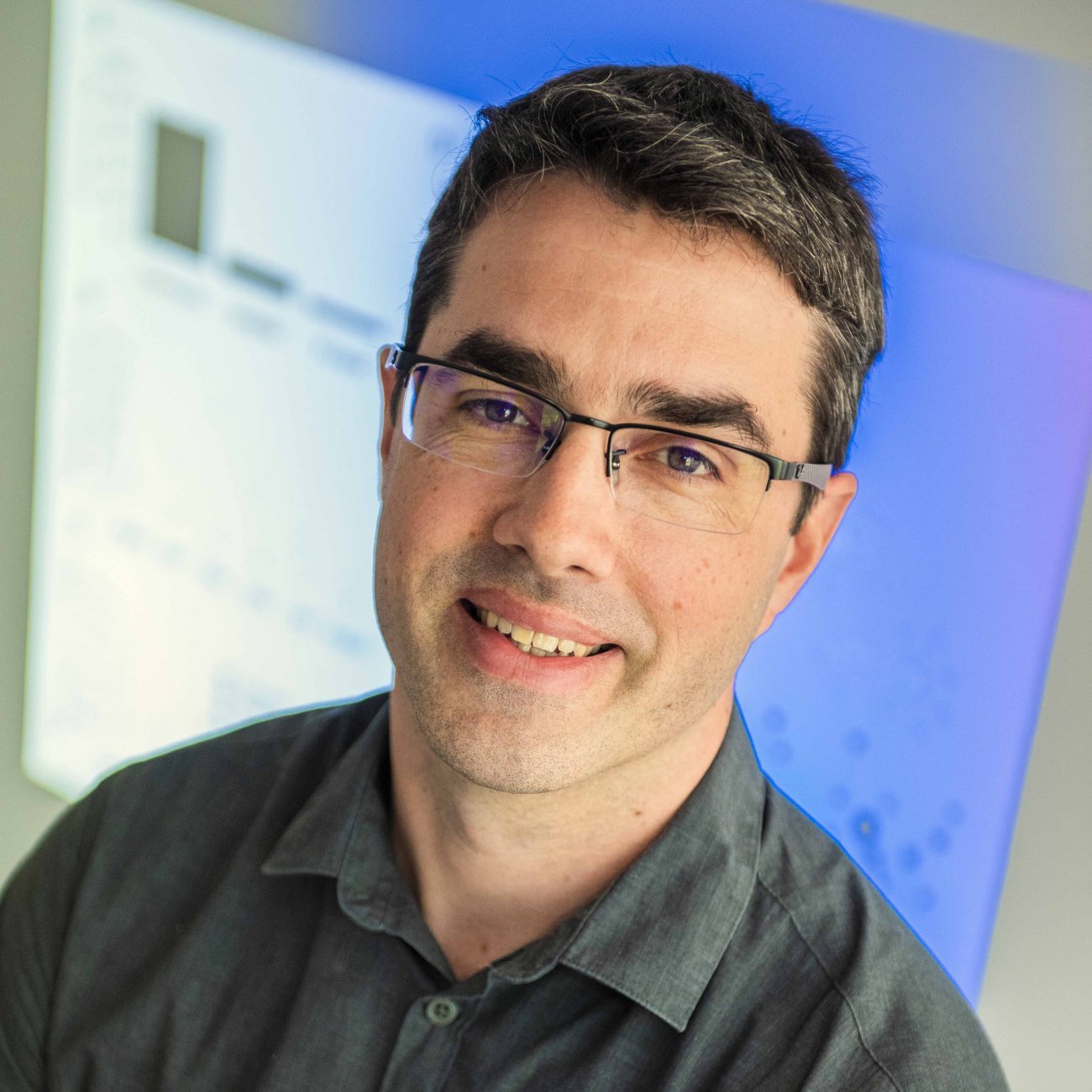
Simon Cauchemez, Head of the Mathematical Modeling of Infectious Diseases Unit (Institut Pasteur, Paris)
Artificial intelligence offers significant opportunities in terms of improving preparedness for health crises.
“Artificial intelligence offers significant opportunities in terms of improving preparedness for health crises. It can speed up heterogeneous data analysis, improve surveillance, refine certain forecasts and help with earlier detection of signs triggering action. It can also augment investigations of variants, transmission dynamics and interactions between biological, environmental and behavioral factors. However, in order for it to make a genuine contribution, stringent conditions must be in place in terms of high-quality, widely accessible and representative data; robust, explicable and rigorously evaluated models to limit bias; and a sufficiently robust ethical framework given the public health challenges faced. The aim is not to pit AI against existing approaches, but rather incorporate it judiciously in epidemiological methods. Its value will be measured not just by its technical performance, but also its ability to make concrete improvements to public health decision-making. To achieve this, cooperation between research bodies, public authorities and civil society will prove crucial.”
Artificial intelligence for modelling infectious disease epidemics. Nature, vol. 638. https://doi.org/10.1038/s41586-024-08564-w
Read the press release: "How AI will make it easier to anticipate future pandemics"
Enodia Therapeutics: from science to drug
A new milestone was set with Enodia Therapeutics in efforts to find a therapeutic application for a breakthrough on the mechanisms of action of mycolactone* achieved through research conducted by the Immunobiology and Therapy Unit. The startup, founded with biotech incubator Argobio Studio and supported by the Institut Pasteur’s Innovation Accelerator, closely combines scientific excellence with biotech development expertise. The value of the approach taken received initial recognition in the form of a fundraising deal worth €20.7 million completed in late 2025. Machine learning lies at the platform’s core, helping to guide the design of more selective small molecules, thus paving the way for a new generation of approaches to fight pathogenic proteins
“This venture shows just how essential it is to establish links between research and industry, learn to collaborate with people whose expertise is different to our own, and develop skills that don’t always come naturally to scientists.”
- Read the press release Argobio and the Institut Pasteur launch Enodia Therapeutics: A biotech company with a new approach for Targeted protein Degradation
- Read the news article Enodia Therapeutics: €20.7 million in funding to translate Institut Pasteur discovery into innovative therapies
*Mycolactone is a toxin that naturally inhibits Sec61, a protein secreted by the bacteria responsible for Buruli ulcers. Enodia Therapeutics is seeking to harness this discovery to degrade pathogenic proteins with a view to treating cancer, inflammatory diseases and viral infections.


At the Ultrastructural Bioimaging Platform. Copyright: Institut Pasteur.
Supporting and enabling developments in AI
1. Information Systems Department
The DSI has developed a hybrid architecture for the AIs hosted within the Institut Pasteur’s infrastructure, based on three principles:
- Confidentiality: sensitive data are hosted internally on proprietary servers. Infrastructure is based on local models ensuring that data never leaves the Institut Pasteur.
- Sovereignty: proprietary and local infrastructure ensures independence and service continuity.
- Cost optimization: a pay-per-use model for occasional use, with costs of intensive use recouped via a local infrastructure.
2. Department of Technology
The Institut Pasteur’s core facilities have the expertise to convert a particular need from a laboratory or product from its research into a tool that can be widely adopted and used by all. For example, the Image Analysis Hub provides all of campus with a ready-to-use set of deep learning image analysis methods based on research conducted in Jean-Christophe Olivo-Marin’s laboratory.
3. Human Resources Department
To help all scientific and administrative teams develop their skills, a training program focusing on acculturation and everyday usage of generative AI was offered throughout 2025. This notably included online training, a masterclass, and seven themed webinars.
The institute’s mission applied to AI
Courses and workshops for PhD students
Since 2024, a 2.5-day artificial intelligence theory course has been offered to all PhD students to help them improve their research skills in areas such as image processing, HTS data analysis, neuroscience and structural biology. This is supplemented by a series of practical workshops specific to structural biology and protein folding, applications in neuroscience, and highthroughput genomic screening.
- Learn more about the Institut Pasteur's course to train scientists to address the challenges of artificial intelligence
Inauguration of PR[AI]RIE-PSAI
The Paris School of AI, led by PSL University in collaboration with Université Paris-Cité, the CNRS, Inria and the Institut Pasteur, opened its doors for the 2025/26 academic year. It offers a full spectrum of programs from bachelor’s to PhD, as well as continuing education, in touch with the latest scientific innovations. The venture also serves as an AI research accelerator through support to several Institut Pasteur scientists in the form of PhD grants and postdoctoral fellowships. PR[AI]RIE-PSAI fosters industrial partnerships in an innovative way, with the aim of forming a global public-private hub of excellence.
- Read the press release (in French) Selection of the Paris-based project: PRAIRIE as the Interdisciplinary Institute for Artificial Intelligence (3IA)
- Read the news article Research, education, and economic development: first assessment of 3ia network actions