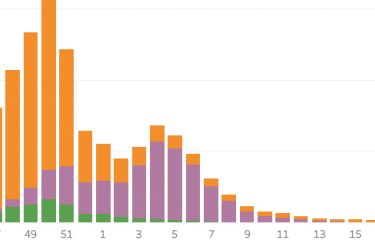


The influenza epidemic is officially under way in France, a little earlier than last year. Every year, the Institut Pasteur monitors respiratory viruses, including influenza. This season it is contributing new expertise, using modeling to forecast the peak of the 2025-2026 outbreak. It is always worth bearing in mind that although seasonal influenza is usually a mild disease, it can also be fatal, especially for vulnerable individuals.
Updated on April 16, 2026.
Read the report on the 2025–2026 season for respiratory infections in France (in French), published by French Health Authorities on 15 April 2026.
With regard to influenza, it is worth noting that the epidemic was caused exclusively by type A viruses, occurring between December 2025 and mid-February 2026 (duration: 10 weeks), with low to moderate intensity in the community but high intensity in hospitals, and with a significant impact on mortality observed in early 2026.
Read in French ‘Acute respiratory infections (influenza, bronchiolitis, COVID-19). Review of the 2025–2026 season.’
- Read below, our news article published on December 31, 2025 -
Influenza remains present across all French regions. Between December 22 and 28, 2025 (week #52), flu indicators kept rising across all age groups in mainland France. Santé publique France reports a "particularly pronounced increase in hospitals, where activity reached a high intensity level across all ages, among children under 15, and among those over 65. In primary care settings, the share of activity for influenza/flu-like illness was at a moderate intensity level across all ages, but decreasing among those under 15, likely linked to the school holiday period. However, it remained at a high intensity level among those 65 and over."
In week #52, France recorded 269 consultations for acute respiratory infections per 100,000 people (compared to 348 consultations in week #51; 281 in week #50; 190 in week #49; 118 in week #48).
See the official document (in French) from French Health Authorities: Infections respiratoires aiguës (grippe, bronchiolite, COVID-19). Bulletin du 31 décembre 2025, updated on Wednesdays.
Flu epidemic: early and severe in 2024-2025, even earlier in 2025-2026
The 2024-2025 influenza epidemic was one of the most severe since 2009. It started early and lasted for a long time, was characterized by an unusual co-circulation of three viruses and had a major impact on the healthcare system, with significant excess mortality (around 17,600 deaths).
The vaccination campaign for the 2025-2026 season began on October 14, 2025, and influenza began to circulate actively from November 26 onwards. Surveillance is essential because influenza outbreaks affect millions of people worldwide every year. Although seasonal influenza is usually a mild disease, it claims hundreds of thousands of lives each year and is especially dangerous for people with a weakened immune system. The severity and scale of seasonal influenza outbreaks need to be monitored closely.
Surveillance by the Institut Pasteur confirms circulation of type A viruses
The National Reference Center for Respiratory Viruses (page in French) at the Institut Pasteur, which for many years has been responsible for monitoring influenza, is currently analyzing approximately 200 samples from general practices, hospitals and medical test laboratories every week. Vincent Enouf, Deputy Director of the CNR, explains that "In most cases, the influenza strains detected are type A viruses, known to be highly virulent. We found several subtypes among the samples tested: A(H3N2) subclade K and A(H1N1)pdm09."
Flu vaccine helps prevent severe forms
Analyses carried out to date indicate that the virus currently in circulation is slightly different from the strain used in the composition of the influenza vaccine produced last summer for the northern hemisphere. The efficacy of the vaccine depends on how similar vaccine strains are to circulating viruses, as well as the age and immune status of the vaccinated individual (see our influenza fact sheet).
"It's not surprising that the flu virus evolves every year," says Vincent Enouf. "The vaccine used this year could be less effective against the A(H3N2) virus*, but even a less effective vaccine can prevent severe forms of disease."
* Preliminary data is however reassuring: initial British data suggests that effectiveness is not reduced compared to what is typically observed for H3N2. This remains to be confirmed. Editor's note.
Institut Pasteur uses modeling expertise to monitor the epidemic for health authorities
This year, the Institut Pasteur and Santé publique France are launching an unprecedented modeling system to help anticipate the dynamics, evolution and peak of the influenza epidemic. "The model provides forecasts of how the epidemic will develop over the next four weeks and the likely peak period," summarizes Simon Cauchemez, Head of the Mathematical Modeling of Infectious Diseases Unit at the Institut Pasteur.
The modeling began on December 10, 2025, when Santé publique France declared that the country had reached the epidemic threshold. "We will be updating the models every week, both regionally (excluding Corsica) and nationally," adds Juliette Paireau, a research engineer in the Institut Pasteur's Mathematical Modeling of Infectious Diseases Unit who is also affiliated with the Infectious Diseases Department at Santé publique France. "Before the model was applied in real time, it was rigorously tested by performing retrospective analyses of several flu seasons." The accuracy of forecasts is limited and depends on the epidemiological and virological dynamics of the influenza virus, which may vary, for example in the event of a new strain.
The use of modeling complements the existing epidemic monitoring and management system, providing a strategic tool to improve preparedness for influenza dynamics, including by adapting procedures in hospitals and stepping up prevention messages.