Microbiology

Practical Information
- 8 weeks
- September 1, 2026 - October 26, 2026
-
Institut Pasteur
- French
Contacts
Registration
Accreditations:
- University Diploma (DU) - Université Paris Cité
- Credits for Université Paris Cité Master 2 degree
- Credits for Sorbonne University Master 2 degree
- Institut Pasteur Diploma
- Université de Paris Cité - Antimicrobial Resistance Graduate School

Description
Master 2 students from partner Universities (Sorbonne University and University of Paris Cité) MUST NOT register online and must submit their registration request DIRECTLY to contacts in charge of their university course. These students have free access to the course.
All other students must register online and pay their registration fees.
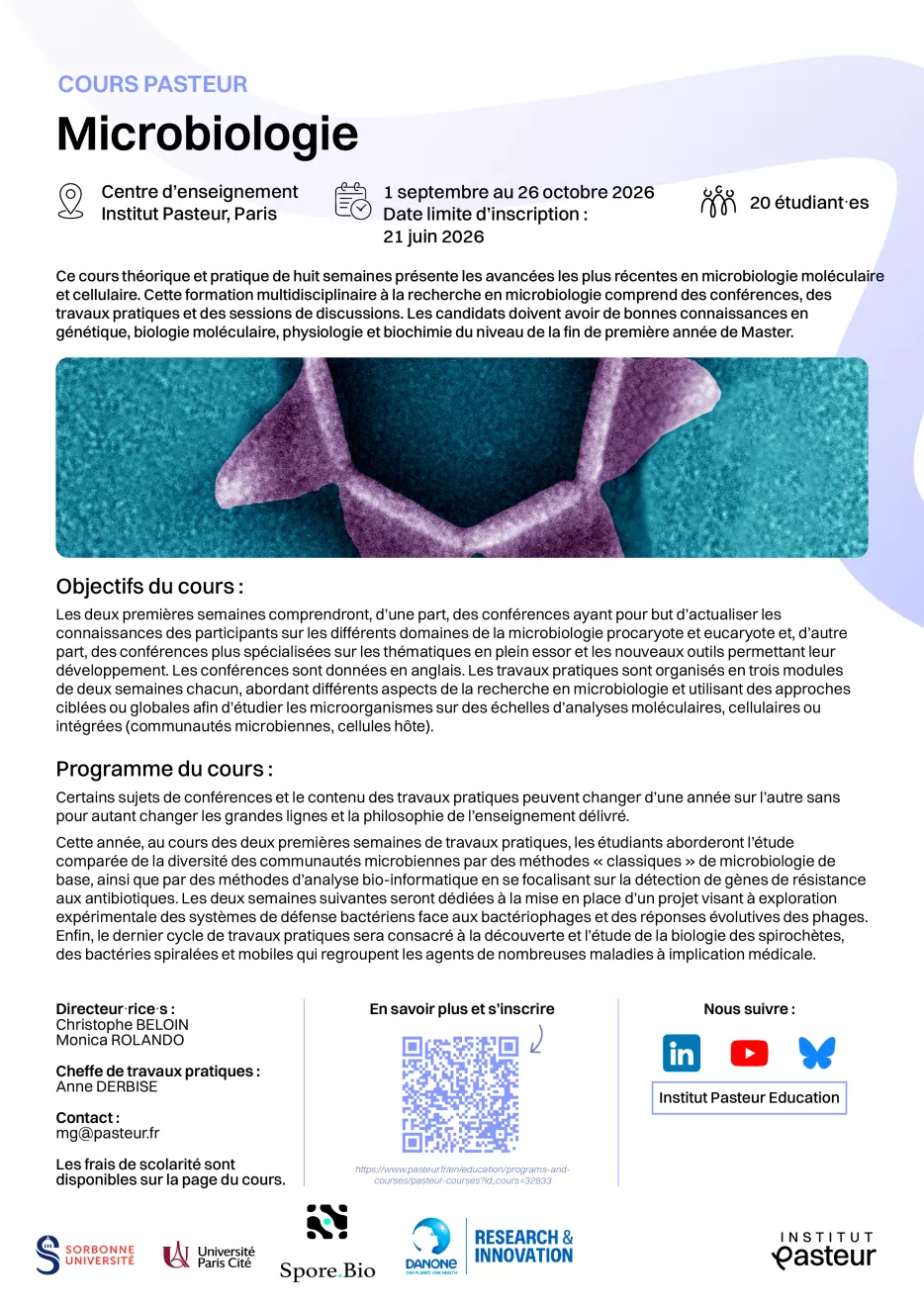
This advanced microbiology research training program presents the latest advances in molecular and cellular microbiology through lectures, practical work, and discussion sessions organized over eight weeks.
Lecture Cycle (2 weeks)
Scientific Program and Supervision: Monica Rolando and Christophe Beloin (Institut Pasteur, Paris).
This training includes, on the one hand, lectures aimed at updating participants' knowledge on various fields of prokaryotic and eukaryotic microbiology, and on the other hand, more specialized lectures and round tables on emerging themes and new tools facilitating their development.
The two weeks of lectures are part of a core curriculum shared by the options Fundamental Microbiology (FM), Molecular and Medical Biology (MMB), and Biology of Eukaryotic Microorganisms (Sorbonne University and Université Paris Cité). 36 speakers (from Institut Pasteur, Paris, and other regions) will cover various models (pathogenic and commensal bacteria, fungi, parasites) as well as new technologies used in microbiology (e.g., bacterial secretion systems, evolution of antibiotic resistance, paleogenomics, bacterial immune systems, etc.).

 ASSESSMENT: Active participation in conferences, writing of a scientific summary, participation in the round table.
TP1 - Biodiversity of microbial communities (2 weeks)
Research Program and Supervision: Julie Leloup (Institut de l’Écologie et des Sciences de l’Environnement, Sorbonne Université, Paris) et Nicolas Kint (Centre des Cordeliers, Sorbonne Université, Paris).
Anne Derbise, Jean Michel Thiberge et Léo Leclerc (Institut Pasteur).
The One Health concept is based on a global approach that interconnects human health, animal health and ecosystem health. One of the emerging themes around this concept is the spread of antibiotic resistance in natural environments, and the need to address health issues through multidisciplinary approaches. Indeed, one of today's major health challenges is antibiotic resistance, responsible for several million deaths, in which the environment and the communities of micro-organisms that make it up, defining the concept of the "microbiome", play an increasingly preponderant role (reservoir, site of horizontal genetic transfers and/or site of selection). Antibiotic resistance is a long-standing phenomenon of natural origin, widespread in the environment and within microbiomes, with a diversity of genetic determinants and multiple phenotypic characteristics. The aim of this course is to study bacterial diversity, focusing on the presence and composition of resistomes, through the exploration and detection of antibiotic resistance genes.
In this practical course, you will identify antibiotic resistance profiles and expression levels, using phenotypic (culture) and molecular (quantitative PCR) approaches based on laboratory strains and natural samples subjected to contrasting exposomes. You will also gain insight into antibiotic-resistant bacterial diversity, and intra- and inter-species carriage diversity through searches of international databases and the literature.
Scientific program and supervision: Julie Leloup (Institut de l'Écologie et des Sciences de l'Environnement, Sorbonne Université, Paris) and Nicolas Kint (Centre des Cordeliers, Sorbonne Université, Paris)
EVALUATION: Ability to work in pairs, classroom and bench behavior, a joint oral presentation on the functioning of antibiotics, their genetic support and resistance mechanisms, and a personal oral presentation on the One Health/natural environments/antibiotics theme. Skills: learn to use a hypothetico-deductive approach; present research results and discuss them constructively in the light of the literature.
TP 2 - Growing on fats : Molecular mechanism of a dual transcriptional regulator
Research Program and Supervision: Emmanuelle Bouveret, Sarah Dubrac, and Isabel Perez-Lopez (Stress, Adaptation and Metabolism in Enterobacteria Unit, Institut Pasteur, Paris).
https://research.pasteur.fr/fr/team/stress-adaptation-metabolism-enterobacteria/
Institut Pasteur Education Supervision: Anne Derbise,Frederique Vernel-Pauillac & Léo Leclerc.
Fatty acids (FA) are the major components of the membranes of all living organisms, and they play essential roles in membrane architecture, homeostasis, and transport. Therefore, FA metabolism occupies a central position in the microbial metabolome, and the pathways involved for their synthesis and degradation are conserved between prokaryotes and eukaryotes. FAs are carboxylic acids (R-COOH) with a long saturated or unsaturated aliphatic chain, and their catabolism relies on the beta-oxidation degradation pathway.
Exogenous FAs can be a source of carbon and energy for bacteria; however, some FAs also display antibactericidal activities. Therefore, bacteria that can consume FAs – like E. coli and related enterobacteria – have the double advantage of both being able to use diet fats, and to remove the potential toxicity of exogenous FAs.
During the training, we will study what kind of FAs E. coli is able to catabolize, and how the beta-oxidation machinery is tuned to FA availability. Using a combination of genetic and molecular tools, we will uncover an exquisite regulatory control mechanism, enabling the bacteria to sense and adapt to FAs present in their environment.

ASSESSMENT: Maintenance of a laboratory notebook, ability to work in pairs, professional conduct in the laboratory and at the bench. A joint oral presentation of the laboratory work results, along with the individual preparation of a scientific article.
TP3 - Arms race in microbial evolution: a practical course on phage defense and counter-defense mechanisms (2 weeks)
Research Program and Supervision: David Bikard, Raphaël Laurenceau, and Florence Depardieu (Synthetic Biology Unit, Institut Pasteur, Paris).
https://research.pasteur.fr/fr/team/synthetic-biology/
Institut Pasteur Education Supervision: Anne Derbise, Frederique Vernel-Pauillac & Léo Leclerc.
This two-week microbiology practical course will guide students in the experimental exploration of bacterial defense systems against bacteriophages and the evolutionary responses of phages. Structured around the concept of the molecular arms race, the course is divided into three hands-on modules. In the first module, students screen a collection of E. coli strains harboring diverse candidate defense systems against a panel of phages, using efficiency of plating (EOP) assays to characterize defense profiles, perform the isolation and phenotypic analysis of phage mutants capable of escaping these defenses, and finally extract and sequence their genomes to identify escape mutations. The second module focuses on experimentally investigating how the bacterial defense system 'senses' the phage infection, by cloning the candidate phage 'trigger' genes on a plasmid and testing their expression in presence of the defense system.
Finally, the third module introduces students to computational tools for the identification and annotation of phage defense systems in genomic data, including the use of HMM profiles and DefenseFinder. Through this integrated approach, students gain experience in experimental design, microbial genetics, molecular biology, bacteriophages, and bioinformatics, while engaging with recent questions in microbial evolution.
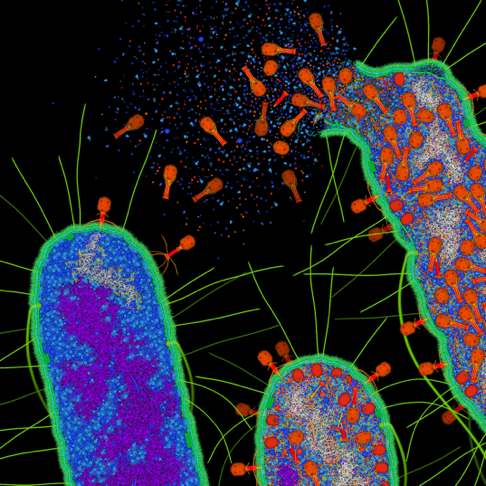
Bacteriophage T4 infection lifecycle Illustration by David S. Goodsell, RCSB Protein Data Bank and Scripps Research. doi: 10.2210/rcsb_pdb/goodsell-gallery-048
ASSESSMENT: Ability to work in pairs, professional conduct in the laboratory and at the bench, maintenance of a laboratory notebook. The laboratory work results will be presented via a joint oral presentation and an individual oral presentation.
More information
 This course is integrated into the Graduate School Antimicrobial Resistance of the University Paris City which aims at developing a training center dedicated to research on antimicrobial resistance. It offers a multidisciplinary research approach addressing the issues from molecular and functional aspects to clinical aspects, also taking into account the social and economic impact. Its teaching programs are built on broad, up-to-date and original approaches that can be used to fight antimicrobial resistance, from prevention to treatment. Focuses include vaccination, detection of pathogens, identification and dissemination, and are supported by leading research expertise.
https://u-paris.fr/en/graduateschools/antimicrobial-resistance/
Vidéos
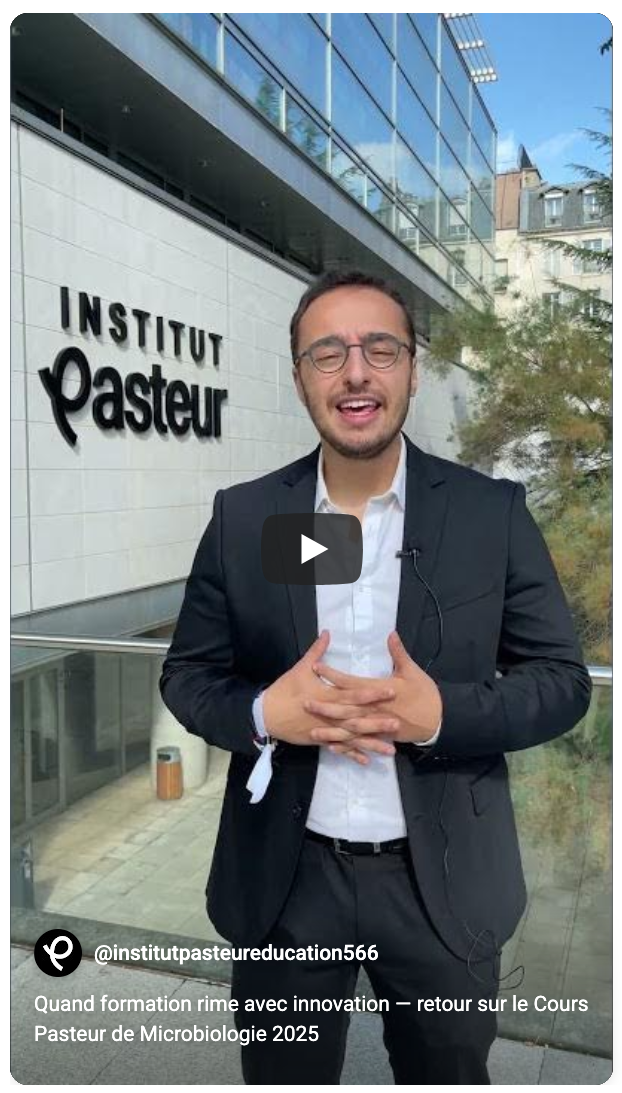
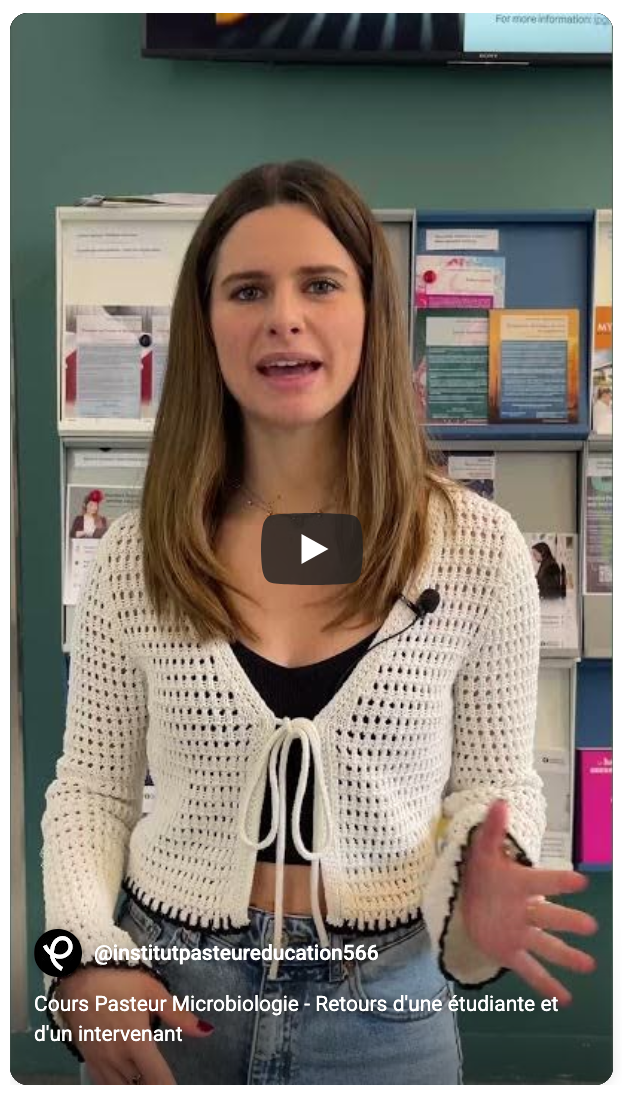
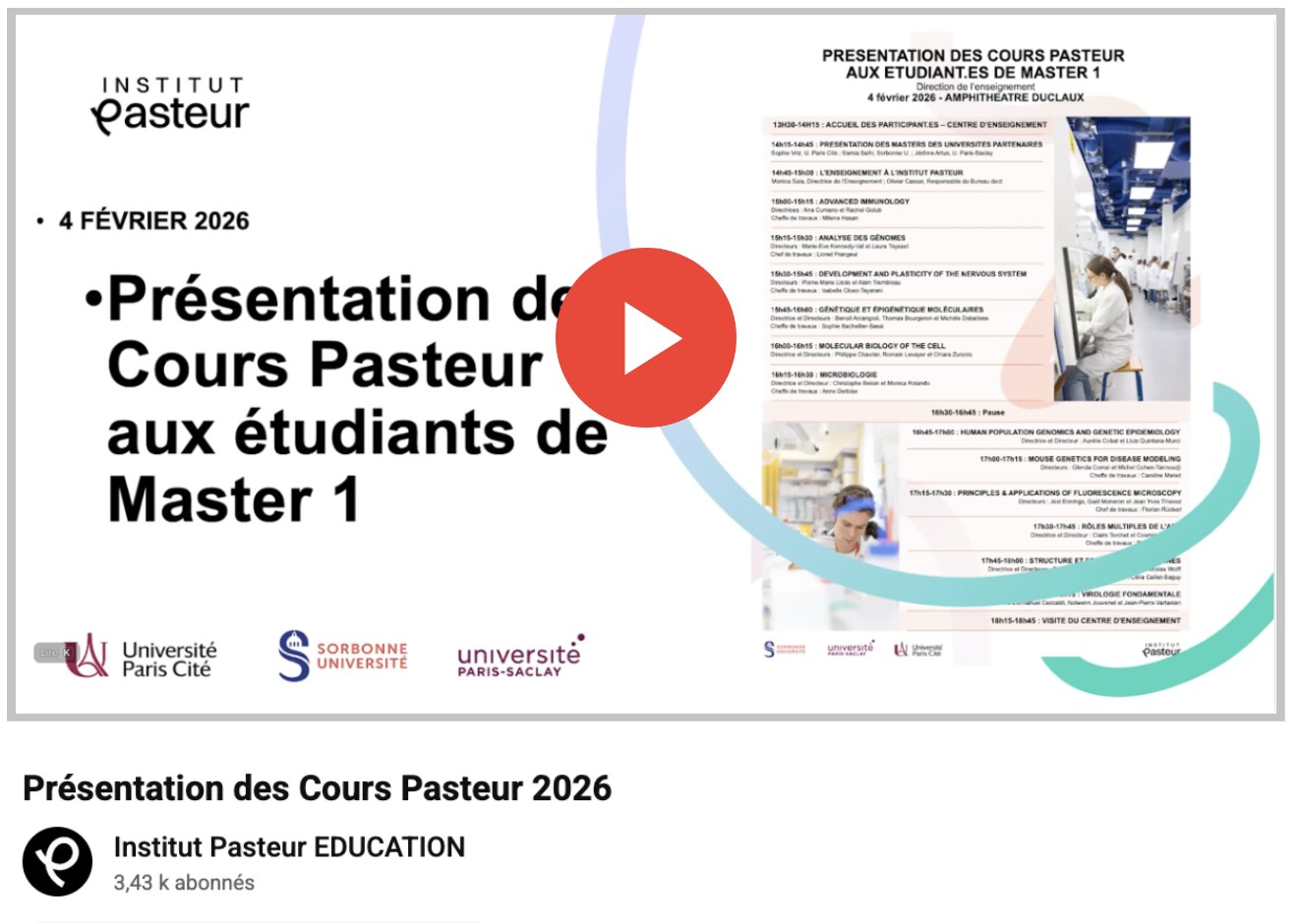
Course presentation for first-year master’s students in February 2026 :
Directors
BELOIN Christophe - Institut Pasteur, Paris
ROLANDO Monica - Institut Pasteur, Paris
Head of laboratory practicals
DERBISE Anne - Institut Pasteur, Paris
Members of the course committee
BELOIN Christophe - Institut Pasteur, Paris
CHERIET Samia - Institut Pasteur, Paris
DERBISE Anne - Institut Pasteur, Paris
JAMET Anne - Université Paris Cité
LEQUEUTRE Isabelle - Institut Pasteur, Paris
NASSIF Xavier * - Université Paris Cité
PONTICELLI Virginie - Institut Pasteur, Paris
ROLANDO Monica - Institut Pasteur, Paris
SALA Monica - Institut Pasteur, Paris
SEZONOV Guennadi * - Sorbonne Université
VERSTRAETE-MARTIN Isabelle * - Université Paris Cité
* Representative of Universities
- Passport Photo
- CV with Publication List
- Motivation Letter (only for General Profile)
- Recommandation Letter (only for General Profile)
- Photocopy CNI or Passport or Residence Permit