2024 Paris Olympics: the Institut Pasteur supports the health authorities

The Institut Pasteur is working actively alongside health authorities to safeguard public health and safety during the 2024 Olympic and Paralympic Games. It will be introducing several measures and initiatives to respond to the challenge of health surveillance during this critical period.
The 2024 Olympic Games in Paris are not just a major sporting event; they also represent a considerable health challenge: 15 million people, including nearly 3 million tourists, are expected to come to Paris and the Greater Paris region to attend the event.
Throughout the Olympic period in France, reference health care institutions will be on the front line in diagnosing individuals experiencing symptoms of contagious diseases.
- Since early 2024, a record number of imported cases of dengue have been recorded in mainland France. The Olympics will see huge numbers of athletes and visitors arriving from all over the world, leading to a potential risk of emergence of arboviruses such as dengue, chikungunya and Zika, or cases of influenza imported by people arriving from the southern hemisphere, where it is currently winter.
- The resurgence in cases of whooping cough and COVID-19 recently observed in France also requires increased surveillance as it could impact those traveling to and from mainland France this summer.
The Institut Pasteur is working actively alongside health authorities to safeguard public health and safety during the 2024 Olympic Games. Drawing on the National Reference Centers (CNRs) attached to its research units and the Laboratory for Urgent Response to Biological Threats (CIBU), the Institut Pasteur will be strengthening its detection, expertise and alert system throughout the period to optimize epidemiological surveillance efforts, in close collaboration with French and international health authorities. Surveillance involves rapidly detecting cases of infectious diseases such as respiratory and gastrointestinal infections, and vector-borne diseases that could emerge during these large gatherings.
The CNRs and CIBU are not alone in responding to this need. Several measures and initiatives introduced by the Institut Pasteur in response to the challenge of health surveillance during this critical period will be reported in the newsletter, including the work of the RENAL/RELAB network and the Institut Pasteur Medical Center, which is gearing up to receive patients.
Contents
Surveillance and investigation - Epidemiological surveillance stepped up at the Institut Pasteur
- National Reference Centers (CNRs) at the ready
- Laboratory for Urgent Response to Biological Threats (CIBU)
COVID-19, influenza and bronchiolitis - The RENAL/RELAB network: heightened surveillance of three respiratory viruses
Patients - Institut Pasteur Medical Center ready to receive patients
International cooperation - Institut Pasteur involved in international cooperation to counter health risks
SURVEILLANCE AND INVESTIGATION
Epidemiological surveillance stepped up at the Institut Pasteur
National Reference Centers (CNRs) at the ready
Fifteen CNRs are hosted at the Institut Pasteur and four at the Institut Pasteur de la Guyane, involving 16 research units or laboratories. The CNRs, together with the Laboratory for Urgent Response to Biological Threats (CIBU), are grouped together in the Multi-Site Reference and Expertise Laboratory (LREMS), a facility that resembles a medical test laboratory.
For the 2024 Olympics, eight CNRs will be particularly ready to respond, namely those involved in monitoring:
- Bacterial infections:
- whooping cough, given the current resurgence in cases in France;
- meningitis, as the risk can increase during large gatherings with a potential concentration of young adults
See The lowdown on meningitis, a public health challenge - leptospirosis, with a particular risk of exposure for athletes competing in outdoor water sports events
See Leptospirosis: understanding why some fresh water bacteria are virulent
- Foodborne bacterial infections:
- listeriosis (Listeria are sometimes known as "refrigerator bacteria");
- infections with Escherichia coli, Salmonella or Shigella
See E. coli, Listeria, Salmonella... - Anatomy of an alert - botulism
See Foodborne botulism: report on the recent outbreak
Although the risk of foodborne infections is very low, if they do occur they can cause severe disease.
- Viral infections responsible for:
- Respiratory infections, including influenza and SARS-CoV-2, given the rise in COVID-19 cases in recent weeks (see RENAL/RELAB network below);
- Arboviruses: the CIBU could be mobilized if there is a recognized risk of chikungunya, dengue or perhaps Zika, depending on imported cases and the activity of tiger mosquitoes (Aedes albopictus) present in mainland France. A recent press release explored how many days it would take for mosquitoes in Greater Paris to transmit arboviruses, and what preventive measures are needed. The CNR responsible for this field is not hosted at the Institut Pasteur in Paris, but the Institut Pasteur de Guyane works in association with it;
Read the press release: Olympics : how many days does it take for mosquitoes in greater Paris to transmit arboviruses, and what preventive measures are needed ? - Viral hemorrhagic fevers: the probability of such diseases is low, but they are monitored because they are particularly severe if they do occur. Some examples of viral hemorrhagic fevers: Crimean-Congo hemorrhagic fever, Lassa fever, Ebola, etc.
The other CNRs at the Institut Pasteur (including those for rabies, plague, cholera, mycoses, hantaviruses, diphtheria and enteroviruses – poliomyelitis in France) should not generally be affected because the diseases they monitor only involve a small number of localized cases and their mode of transmission means that they do not represent a risk.
Anna-Bella Failloux, medical entomologist at the Institut Pasteur, explains how to live with the tiger mosquito this summer. (Video in french)
Laboratory for Urgent Response to Biological Threats (CIBU)
At the Institut Pasteur, the CIBU is gearing up for the Olympics and will be ready to intervene if suspicious cases of fever or other symptoms are reported. Its role is to quickly identify the pathogen responsible for a patient's symptoms based on samples sent by hospitals in Paris, with the aim of avoiding a potential outbreak.
For the past year and a half, the CIBU has been preparing so that it can respond to as many requests as possible by developing new tests that also detect tropical diseases and by strengthening its methods and team.
Where previously the CIBU was able to detect 3 to 5 viruses with a single test based on a single sample taken from a patient, now up to 24 different viruses and bacteria can be identified in less than 2 hours.
It is important to obtain rapid results so that patients can be isolated as quickly as possible.
Some 27 scientists and engineers will be on call day and night, 24/7, including 3 additional staff members for the Olympic period.
The role of the Institut Pasteur's Laboratory for Urgent Response to Biological Threats (CIBU) during a potential health crisis at the 2024 Olympics. Copyright: Institut Pasteur (Video in french)
COVID-19, INFLUENZA AND BRONCHIOLITIS
The RENAL/RELAB network: heightened surveillance of three respiratory viruses
During the Paris Olympics, the RELAB network will be particularly active, together with the RENAL network in hospitals, and will be in a position to inform health authorities of the epidemic situation with regard to respiratory viruses on a weekly basis.
RELAB is a surveillance network involving non-hospital-based medical test laboratories. The network monitors the real-time spread of the respiratory viruses responsible for the following diseases, in all regions of France and for different age groups:
- COVID-19;
- influenza;
- bronchiolitis.
In its pilot configuration, thousands of biological samples are analyzed daily by the Biogroup and Cerballiance medical test laboratories, and clinical information is collected from patients undergoing tests. The anonymized data are then sent to the National Reference Center (CNR) for Respiratory Viruses (Hospices civils de Lyon and Institut Pasteur in Paris), where they are analyzed.
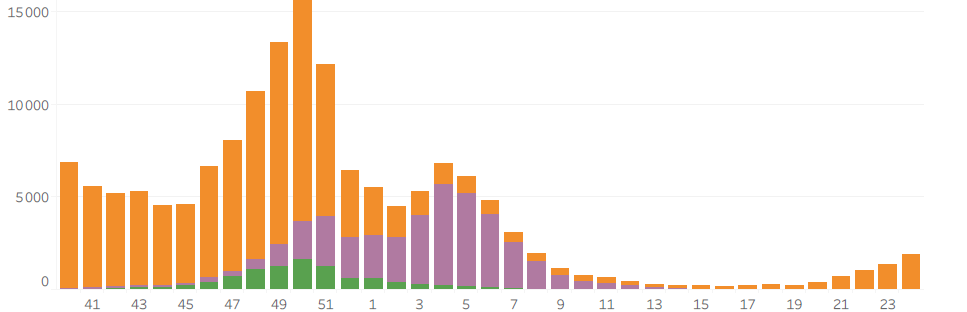
Example of a graph based on an analysis of RELAB data for real-time monitoring of the epidemic dynamics of respiratory viruses in France. The colors represent the number of positive samples each week for COVID-19 (orange), RSV (green) and influenza (purple). © HCL, Institut Pasteur, Biogroup, Cerballiance
The RELAB network, in conjunction with the RENAL and Sentinelles networks, is therefore able to offer a comprehensive picture of the epidemic dynamics of respiratory viruses among the French population. Every week throughout the year, it provides information about the most exposed regions and individuals so that behavior can be adapted accordingly, health authorities can be informed about epidemic situations, and potential congestion in hospitals can be anticipated.
Read the press release: RELAB network: real-time monitoring of respiratory viruses in the French population (in French)
PATIENTS
Institut Pasteur Medical Center ready to receive patients

Medical Center of the Institut Pasteur. Copyright: Institut Pasteur
The Institut Pasteur Medical Center (CMIP) specializes in prevention, especially before foreign travel, with its International Vaccination Center. It is also involved more generally in treating travel-related diseases or people who have been exposed to health risks while abroad. It hosts the Anti-Rabies Center for the Greater Paris Region and offers consultations for infectious and tropical diseases, aimed at patients with chronic infections and also those with acute infectious diseases, whether tropical or not.
The Medical Center can be accessed rapidly by anyone with febrile illness, including without an appointment, after initial telephone screening. It works in collaboration with a nearby medical test laboratory and can offer rapid diagnosis for most infectious diseases, especially for returning travelers, such as malaria, dengue or other milder diseases such as travelers' diarrhea or tropical skin conditions (leishmaniasis, cutaneous larva migrans, etc.).
For the duration of the Olympics and Paralympics, the Medical Center is available to receive any patients – including those traveling to France for the Games – with symptoms related to its areas of expertise, especially febrile illness.
INTERNATIONAL COOPERATION
Institut Pasteur involved in international cooperation to counter health risks
Mass gatherings and microbial composition (virome and microbiome) of air in community settings in the Greater Paris Region
The Environment and Infectious Risks Unit at the Institut Pasteur is leading a project to characterize the microbial composition (virome and microbiome) of air in crowded urban spaces (restaurants and bars). The study will be based on air samples collected twice a week over a six-week period from July 15 to August 25, 2024, in other words before, during and after the Olympics. The aim is to assess whether a mass gathering of this scale has an impact on the microbial diversity and genomic load of air in community settings. Microbial genomic diversity will be characterized using broad-range molecular detection methods (multiplex syndromic PCR) and metagenomics.
The research will be carried out in collaboration with the Laboratory of Clinical Microbiology and the Laboratory of Viral Metagenomics at KU Leuven, as part of the DURABLE network (Delivering a Unified Research Alliance of Biomedical and Public Health Laboratories against Epidemics). The teams have many years’ experience in developing this type of study; they have carried out air sampling research in Belgium in a variety of contexts, especially in community settings (hospitals, stadiums, canteens, schools, care homes, etc.).
The project relies on a unique collaboration between the Institut Pasteur and KU Leuven involving staff, equipment and expertise at the two institutions.
Beyond the Olympic Games, the Institut Pasteur continues to pursue its cooperation with several international institutions to share data, resources and expertise. This collaborative approach facilitates research into certain health risks (e.g. studying the microbial composition of air, see above), enables a quicker, coordinated response in the event of disease outbreaks, improves knowledge of diseases transmitted by insect vectors, and creates opportunities for studying health risks.
- DURABLE: a large-scale project on Emerging diseases within the EU4Health European program
- AMAZED: harnessing the potential of the Pasteur Network to investigate vector-borne diseases
- MediLabSecure – strengthening Multisectoral and Regional Cooperation to Mitigate Vector-Borne Diseases in the Mediterranean