Multiple roles of RNAs

Practical Information
- 2 weeks
- February 15, 2027 - February 26, 2027
-
Institut Pasteur
- French
Contacts
Registration
Accreditations:
- Université Paris Cité – G.E.N.E Graduate School
- Credits for Université Paris Cité Master 2 degree
- Credits for Sorbonne University Master 2 degree
- Institut Pasteur Diploma
Description
Master 2 students from partner Universities (Sorbonne University and University of Paris Cité) MUST NOT register online and must submit their registration request DIRECTLY to contacts in charge of their university course. These students have free access to the course.
All other students must register online and pay their registration fees.
Classically, the diversity of RNA molecules was shared between the well known protein coding messenger RNAs (mRNA) and splicing and translation related tRNA, snRNA, snoRNA or rRNA. The discovery of novel classes of RNA (miRNA, piRNA, CRISPR,…) shed light on new major roles of RNA in cell biology and generated a tremendous amount of interest in RNA related work. Thus, recent developments revealed a crucial role for RNA in regulating gene expression via transcriptional and post-transcriptional control mechanisms. Deep RNA sequencing and high-resolution microarrays also revealed the existence of a highly complex population of non-coding transcripts and sophisticated nuclear and cytoplasmic related surveillance mechanisms. It became thus obvious that organisms have developed several levels of surveillance mechanisms to clean up unwanted transcripts, from aberrant mRNAs to unstable transcripts.
Video :
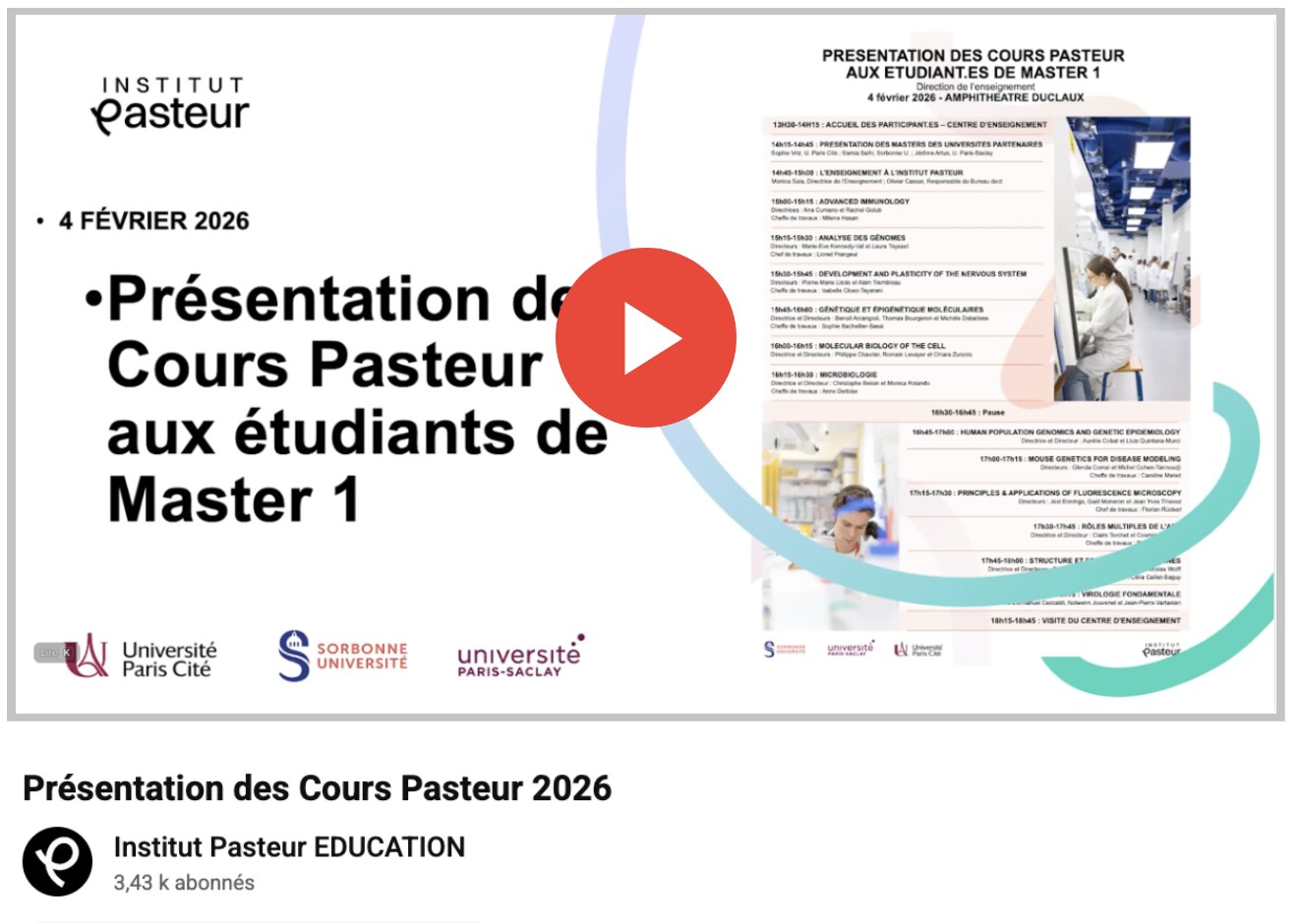
Course presentation for first-year master’s students in February 2026 :
We propose in this practical course to explore in detail the substrates and mechanisms of a major translation-dependent RNA degradation pathway, the Nonsense Mediated mRNA Decay (NMD). NMD degrades transcripts with premature stop codons through poorly understood mechanisms that are conserved from yeast to humans.
The lectures will be delivered by RNA specialists who will focus on the multiple roles of RNA and specific technologies related to RNA studies.
The aim of the practical course is to learn classical and innovative RNA-related techniques that include transcriptome analysis using RNA-Seq, northern blots and RT-qPCR and the study of different RNA populations that physically associate with the NMD machinery. We will compare transcripts from a wild-type strain and from a mutant strain in which an essential NMD factor gene has been deleted. The analysis of genome-wide results will integrate both biochemical association data (co-purification of RNA) and phenotypic data (changes in RNA abundance) to illustrate the diversity of NMD targets.
To get detailed information on the general frame of the course, please refer to the program, that can be downloaded; some topics and practical work schedule change every year.
Candidates must have a good knowledge of genetics, molecular biology and biochemistry (level Master 2), as well as a minimum B1 level in both French and English. Applicants will be evaluated and selected by the course committee.
Directors
SAVEANU Cosmin - Institut Pasteur
TORCHET Claire * - Sorbonne Université
Head of laboratory practicals
LEGENDRE Rachel - Institut Pasteur
Members of the course committee
BADIS-BREARD Gwenael - Institut Pasteur
BECKER Hubert * - Sorbonne Université
CHERIET Samia - Institut Pasteur
DAUGERON Marie-Christine * - Université Paris-Saclay
DORRELL Francesca - Institut Pasteur
MEDJKANE Souhila * - Université Paris Cité
PONTICELLI Virginie - Institut Pasteur
SALA Monica - Institut Pasteur
SAVEANU Cosmin - Institut Pasteur
TORCHET Claire * - Sorbonne Université
* Representative of Universities
- Passport Photo
- CV with Publication List
- Motivation Letter (only for General Profile)
- Photocopy CNI or Passport or Residence Permit