Modeling of infectious diseases

Practical Information
- 1 week
- March 8, 2027 - March 12, 2027
-
Institut Pasteur
- English
Contacts
Registration
Accreditations:
- University Diploma (DU) - Université Paris Cité
- Université de Paris Cité - “One Health-Emerging Infectious Diseases Graduate School” (1H-EID)
- Doctoral School Module
- Institut Pasteur Diploma
- Credits for the Advanced Master degree in Global Health within the Pasteur-Cnam-EHESP School of Public Health
Description
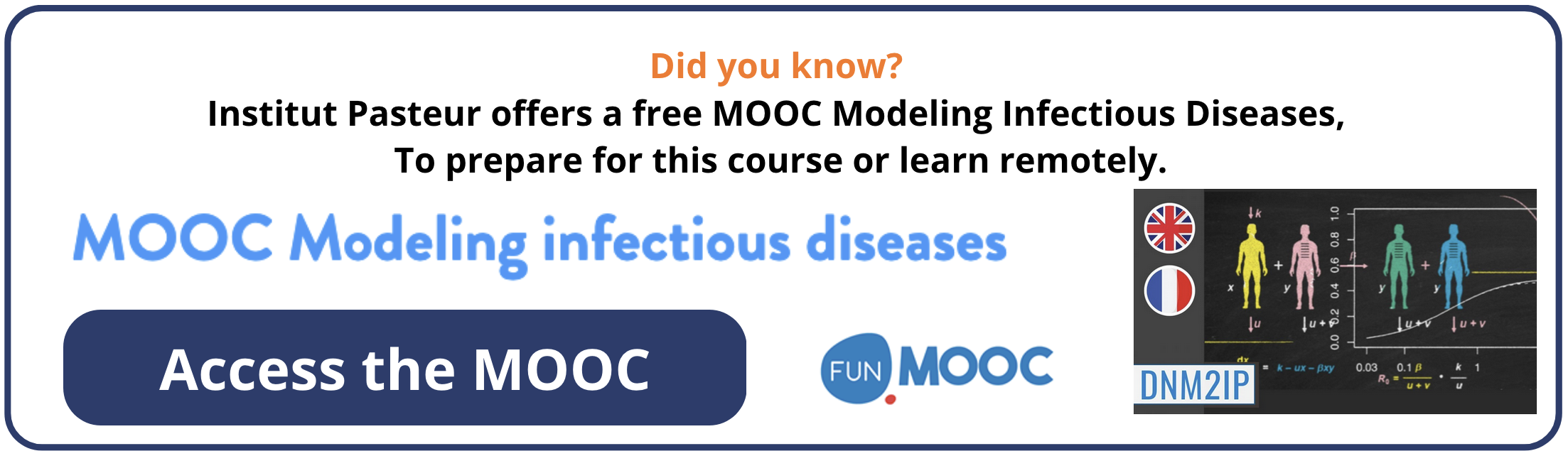
Mathematical modeling has become an essential tool for the study of infectious disease epidemics, making it possible to better characterize the complex transmission dynamics inherent to the spread of pathogens in human populations. Mathematical models are now commonly used to address a variety of questions that can inform policy making, for example, the optimal allocation of control measures, the planning and evaluation of vaccination programmes, nowcasting and forecasting of epidemics and real-time risk assessment during epidemics.
This one-week course aims at introducing the main modeling techniques and applications to students and professionals in science, medicine and public health. The main learning objectives of the course are that participants:
1) understand the key theoretical concepts and techniques of infectious disease modeling;
2) can read modeling papers, understand the strengths and limits of modeling approaches; and are able to use modeling results in their own research and effectively interact with modelers. To achieve these objectives, the course will be partitioned in three types of sessions: a set of lectures introducing key theoretical concepts and techniques, a seminar series illustrating how these concepts are being used to tackle major Public Health challenges, and practical sessions during which participants will learn to implement, run and use models.
A Masters or BSc degree is required, as well as basic math knowledge (high school-level knowledge on derivatives, basics of probabilities and statistics).
Directors
CAUCHEMEZ Simon - Institut Pasteur
TEMIME Laura - Institut Pasteur
Members of the course committee
CAUCHEMEZ Simon - Institut Pasteur
CHERIET Samia - Institut Pasteur
DORRELL Francesca - Institut Pasteur
PONTICELLI Virginie - Institut Pasteur
SALA Monica - Institut Pasteur
TEMIME Laura - Institut Pasteur
- Passport Photo
- CV with Publication List
- Motivation Letter (only for General Profile)
- Photocopy CNI or Passport or Residence Permit