CAIDERA: Training the Next Generation of Researchers and Strengthening the Fight Against Infectious Diseases in Central Africa

CAIDERA: An International Program Advancing Health in Central Africa
How can we train a new generation of scientists equipped to better understand, prevent, and combat infectious diseases?
This is the goal of CAIDERA (Central African Infectious Disease and Epidemics Research Alliance), a collaborative program led by the University of Tübingen, the Centre de Recherches Médicales de Lambaréné (CERMEL) in Gabon, and Institut Pasteur, with support from international scientific partners, including the Pasteur Network.
Funded through the DAAD’s Global Centers program, CAIDERA brings together education, interdisciplinary research, and knowledge sharing to address public health challenges in Central Africa. Its research focuses in particular on infectious diseases, including malaria and other diseases affecting children in sub-Saharan Africa, as well as on developing research approaches tailored to the region’s needs.
Education is central to this collaboration, with Institut Pasteur contributing its expertise in online learning. The program aims to equip students and early-career researchers with the knowledge and skills they need to make a lasting contribution to research and the fight against infectious diseases.

A Master’s Program, Scholarships, and Online Learning Opportunities

One of CAIDERA’s major achievements is the development of the Infection Biology and Control master’s program, a two-year degree focused on infection biology and control. Offered at CERMEL in Gabon in collaboration with the University of Tübingen and Institut Pasteur, the program combines coursework, research, and hands-on field experience. It welcomes students from different African countries and serves as an example of international cooperation in higher education.
Two cohorts have started the program, in 2023 and 2025. Scholarships help support the educational pathways of participating master’s and doctoral students.
CAIDERA also supports the development of free digital learning opportunities through Institut Pasteur’s MOOCs (massive open online courses). The program has supported the creation of a MOOC on neglected tropical diseases and the update of the malaria MOOC, both priority health issues for the region. Students in the master’s program can also earn the Institut Pasteur Digital Diploma in Infectious Diseases (DNM2IP) by completing five MOOCs as part of the program.
CAIDERA at a Glance (2021–2025)
- 1 master’s program developed and offered in Gabon
- 21 scholarships awarded to master’s and doctoral students
- 2 MOOCs financially supported
- 35 publications in peer-reviewed scientific journals
- These results demonstrate the complementary roles of degree programs, support for early-career scientists, digital learning, and research.
In Berlin, Sharing Experiences and Educational Tools

The third symposium of the DAAD-funded Global Centers, held in Berlin in 2026, brought together partners from eight centers fostering collaboration between Germany, Africa, Asia, and Latin America. Four centers focus on climate and the environment, while the other four work on health and pandemic prevention.
Institut Pasteur was represented by Thierry Lang, Head of International Education & Services Hub, and Clémentine Schilte, Head of the Digital Education Hub. They led workshops to share Institut Pasteur’s experience and encourage knowledge exchange among the centers.
Ten Years of MOOCs at Institut Pasteur: Sharing Practical Expertise
The workshop “Learnings from 10 Years of MOOCs: A Practical Guide for Global Centers” drew on Institut Pasteur’s decade of experience designing open online courses.
Participants explored the main stages of MOOC development, with the goal of providing practical guidance to institutions looking to create their own digital learning programs.
The discussions revealed strong interest in this approach and provided an opportunity to share best practices for developing scientific content, assessing learning outcomes, and engaging learners.
Watch the video celebrating 10 years of MOOCs at Institut Pasteur
Looking Back at the COVID-19 Pandemic to Compare Perspectives
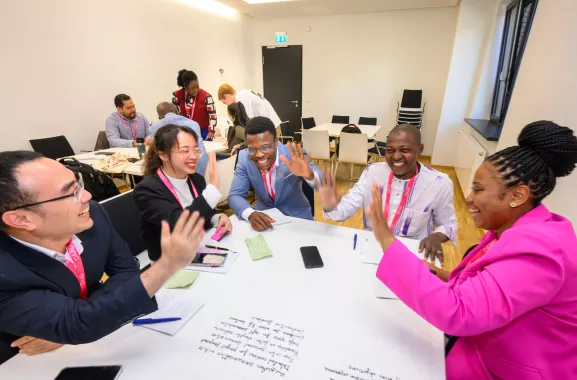
The second workshop, “Take a Look Back at the COVID Pandemic,” invited participants to compare responses to the pandemic in France, Vietnam, and Gabon using timelines that combined epidemiological data with government measures.
Working in small groups, participants shared their personal and professional experiences and discussed different crisis management strategies. The workshop was presented with Alejandra Duque, CAIDERA Project Manager, and Theresa Kahl, CAIDERA Study Program Coordinator, both affiliated with the Institute of Tropical Medicine at Tübingen University Hospital.
Bringing together participants from different countries, generations, and professional backgrounds fostered dialogue between national experiences and perspectives from the biomedical, social, and human sciences.
In connection with this topic, explore our YouTube playlist on epidemic preparedness
Building Skills, Sharing Knowledge, and Fostering Long-Term Collaboration
Through CAIDERA, Institut Pasteur helps develop the scientific expertise needed to address health challenges in Central Africa. The master’s program, scholarships, MOOCs, and research collaborations all contribute to building an educational offering tailored to the region’s needs.
The Berlin symposium provided a forum for international partners to share experiences and teaching practices. It also highlighted Institut Pasteur’s expertise in digital education, supporting the development of new scientific training initiatives.


