HIV: Lenacapavir Also Acts Within the Nucleus of Infected Cells

Scientists at the Institut Pasteur have published a study in Science Advances revealing a previously unknown mechanism of action for lenacapavir, observed at biologically relevant doses. This antiviral drug is among the most promising treatments for HIV.
HIV remains a virus that is difficult to eliminate
Despite current treatments, more than one million people contract HIV each year worldwide. Antiretroviral drugs help control the virus but do not eliminate it completely: HIV can persistently hide in certain cells of the body, forming what are known as “viral reservoirs.” These reservoirs are one of the main obstacles on the path to a cure.
It is against this backdrop that a new generation of treatments has emerged. Lenacapavir, the first member of a novel class of drugs—capsid inhibitors—has been approved for the treatment of HIV and for prevention (PrEP). Administered by injection just twice a year, it has demonstrated very high efficacy, including in individuals carrying strains of the virus resistant to other treatments. However, the reasons for this exceptional potency remained only partially understood.
Understanding how lenacapavir works inside the cell nucleus
The capsid is a protein shell that encloses and protects HIV’s genetic material inside the infected cell. Francesca Di Nunzio’s Advanced Molecular Virology team at the Institut Pasteur has shown that lenacapavir keeps this capsid intact all the way to the center of the cell, right into the nucleus—the compartment where human DNA is stored.
Yet it is precisely there that a decisive step takes place: to replicate, HIV must integrate its genetic material into the host cell’s DNA, targeting regions rich in active genes. By keeping the capsid intact longer, lenacapavir disrupts this process: the virus is redirected to areas of DNA that are much less conducive to its replication, where its integration becomes highly inefficient. Its ability to replicate is thus severely compromised.
The main results of the study
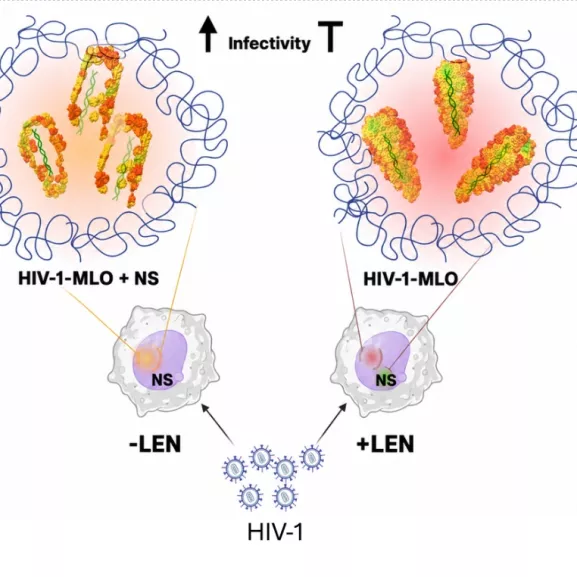
The figure on the right summarizes the main results of the study. In the absence of lenacapavir (LEN), HIV-infected cells exhibit capsids that have been emptied of their contents within HIV-1-induced membrane-less organelles (HIV-1-MLO). These condensates fuse with nuclear speckles (NS), which are surrounded by open chromatin, thereby promoting the progression of infection (left). In the presence of LEN, the viral capsids remain more stable and are not directed toward the NS. Consequently, viral infection is significantly reduced (right).
Cutting-edge technologies have made it possible to observe how lenacapavir works
These results were obtained through a combination of advanced technological approaches developed at the Institut Pasteur:
- cryo-electron microscopy,
- cryo-electron tomography,
- high-resolution imaging,
- and molecular simulations.
Together, these approaches made it possible to observe the virus directly inside the nuclei of infected cells—a breakthrough that opens new windows into the biology of the infection.
Understanding how lenacapavir works to develop new strategies aimed at finding a cure one day
While this research does not alter the clinical use of lenacapavir, it significantly enhances our understanding of its mechanism of action. Pinpointing exactly how the virus is diverted from its usual target in DNA could, in the long term, guide the development of new strategies to limit HIV persistence in the body—and bring us closer to a functional cure.
This study was primarily funded by the "PTR-Carnot" research programs and the French agency "ANRS Emerging infectious diseases" (also called ANRS MIE, in French).