Anne Marie Wehenkel: what to do when antibiotics no longer work

The lightbulb moment: a science workshop on a school trip
It all started at the National Museum of Natural History in Luxembourg during an afternoon of science workshops organized by her biology teachers. Anne Marie Wehenkel was 14 or 15 at the time, and the hands-on DNA extraction activity led by a group of scientists from the UK immediately had her hooked.
"It was just amazing – the scientists were so interesting and keen to share their knowledge"
In that moment, her future path was decided: she wanted to study biology, and she wanted to study it in the UK. Aged 19, Anne Marie left Luxembourg and set off for the University of Edinburgh, Scotland, to complete a four-year undergraduate degree in what she found to be an inspiring environment. She immediately took to life at Edinburgh, where lecturers treated students as equals and dialog was encouraged. After her degree she decided to move to Paris, joining the Institut Pasteur for a research Master's and then a PhD in structural biology focusing on the target proteins of Mycobacterium tuberculosis bacteria, supervised by Pedro Alzari. Her international research career took her to Milan, then to the Max Planck Institute in Dortmund for a postdoctoral fellowship on human cell division, followed by a stint at the Institut Curie in Orsay, where she worked on the eukaryotic cytoskeleton. She came back to the Institut Pasteur for good in 2016, this time to build her own research program.
One equals two: bacterial division
Anne Marie Wehenkel, who became a Research Director in 2024, leads the five-year unit on Bacterial Cell Cycle Mechanisms.
The question driving her research seems straightforward: how does one bacterium become two?
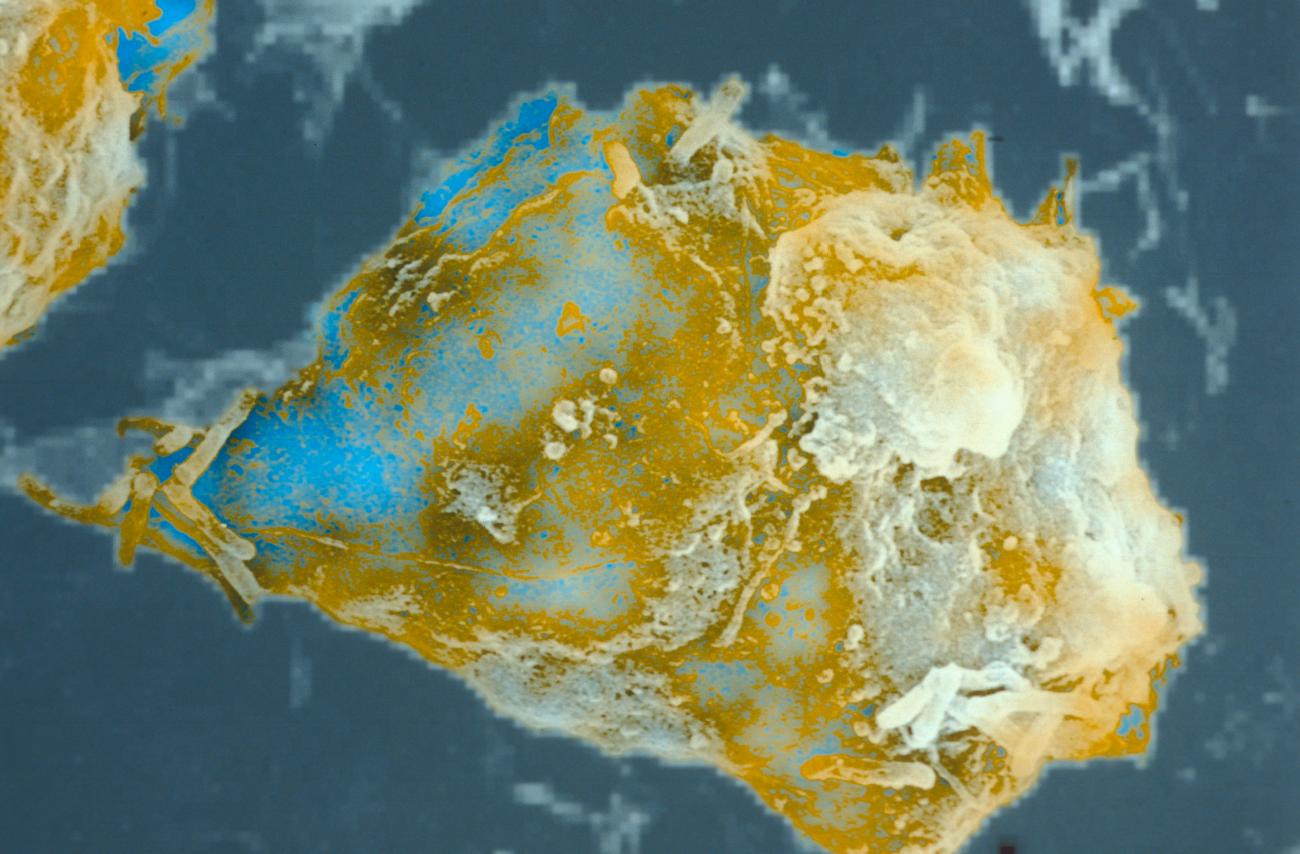
Yet behind this basic enigma lies a major medical challenge. The organism that particularly interests Anne Marie is Mycobacterium tuberculosis, the causative agent for a disease that continues to have a devastating impact on the world's poorest regions. Current treatment regimens, most of which date back to the 1950s, are complex and burdensome, lasting for months or even years and causing severe side effects. The rise in antibiotic resistance has highlighted the urgent need for new therapeutic targets. To overcome the challenges of working directly with the tuberculosis bacillus, which can only be handled in a high-security laboratory, the scientist works with Corynebacterium glutamicum, a non-pathogenic bacterium used in the food industry to produce glutamate, which has a unique, complex cell wall very similar to that of tuberculosis. Her team adopts an interdisciplinary approach, combining atomic-scale research with whole-cell techniques. Anne Marie is also working with Christophe Zimmer, a computational biology specialist at the Institut Pasteur, to develop an AI-based screening tool. This deep learning model, trained to recognize the effect of known antibiotics on bacterial morphology, can classify new compounds and identify novel mechanisms of action.
Tuberculosis: an unfinished victory
Long known as "consumption" or "white plague," tuberculosis (TB) devastated the European population throughout the 19th century, affecting people of all social classes. In 1882, the German bacteriologist Robert Koch identified the agent responsible, Mycobacterium tuberculosis. This groundbreaking discovery paved the way for scientific methods to tackle the disease.
It was at the Institut Pasteur that the first tuberculosis vaccine – the BCG, or Bacillus Calmette-Guérin – was developed by Albert Calmette and Camille Guérin in 1921, after 13 years of research. It is still used today in many countries and provides effective protection for young children against severe forms, although it has not eradicated the disease.
The major therapeutic breakthrough came after the Second World War, following the discovery of streptomycin, the first effective antibiotic against Mycobacterium tuberculosis, in 1943. This was a key turning point: the use of streptomycin in combination with other drugs over the following decades drastically reduced the incidence of TB in Western countries, to such an extent that the BCG vaccine has not been compulsory in France since 2007.
But the victory is a partial one. Tuberculosis is still the deadliest infectious disease in the world after COVID-19, claiming nearly 1.5 million lives every year according to WHO figures. Even more worrying is the emergence of multidrug-resistant strains for which there are dangerously few therapeutic options. This makes Anne Marie Wehenkel's work more important than ever.
The Pasteurian approach – cultivating critical thinking
What attracts Anne Marie Wehenkel about the Institut Pasteur is what she calls the "critical mass" – the uniquely high concentration of specialists, state-of-the-art core facilities and multidisciplinary expertise in the same place.
"The worst thing that could happen is if everyone says "Yes, it's great!"
The Institut Pasteur also provides her with colleagues who challenge her theories and help her develop her thinking. When she came back in 2016, she completed training to use the Institut Pasteur's microscopy core facilities, taking advantage of equipment that few institutes could offer at such a scale. For a researcher working on basic biology, cutting-edge imaging and the search for new antitubercular drugs, the Institut Pasteur offers a unique and highly productive scientific ecosystem. As the leader of a team of a dozen people, driven by a curiosity that has never wavered since her first DNA extractions as a teenager, Anne Marie Wehenkel combines scientific rigor with a razor-sharp determination to tackle the major health challenges facing the world now and in the future.
At a time when antibiotics are reaching their limits in the face of increasingly resistant bacteria, we are exploring a new approach: using a harmless bacterium to try to uncover the Achilles’ heels of the tuberculosis bacillus, which could one day become new therapeutic targets.
Anne Marie Wehenkel: Key Dates
Professional Background
Since 2024: Principal Investigator / Research Director (Directrice de Recherche)
Head of the Bacterial Cell Cycle Mechanisms Unit, Institut Pasteur, CNRS UMR 3528, Université Paris Cité.
2022–2023: Group Leader – Bacterial Cell Division Mechanisms, within the Structural Microbiology Unit (Prof. P. Alzari), Institut Pasteur, France.
2016–2024: Researcher (Senior Research Scientist/Chargée de recherche expert, Institut Pasteur, from January 2018) within the Structural Microbiology Unit (Prof. P. Alzari), Institut Pasteur, France.
2012–2015: Research position funded by an ANR PDOC fellowship, Institut Curie, Orsay, France (host laboratory: C. Janke).
2008–2012: Postdoctoral Fellow, Max Planck Institute of Molecular Physiology, Dortmund, Germany (2011–2012) and European Institute of Oncology, Milan, Italy (2008–2011) (Laboratory of Prof. A. Musacchio).
2007–2008: Postdoctoral Fellow, Institut Pasteur, Paris, France (Structural Biochemistry Laboratory of Prof. P. Alzari).
Education / Degrees
2020: HDR (Habilitation à Diriger des Recherches – Accreditation to Supervise Research), Université de Versailles Saint-Quentin-en-Yvelines, Paris-Saclay.
2003–2007: PhD, Université Paris VI (Pierre et Marie Curie), France (distinction: *très honorable*).
2002–2003: Master’s degree, Université Paris VI (Pierre et Marie Curie), France (distinction: *bien*). 1998–2002: Bachelor’s degree with honours (first class) in Biochemistry, University of Edinburgh, United Kingdom.
Award for the best undergraduate project in Molecular Biology, University of Edinburgh.
1998: Baccalaureate (secondary school leaving diploma), Lycée Classique d'Echternach, Luxembourg – Natural Sciences and Mathematics stream.