March 1886: When Louis Pasteur Himself Collected the First Donations for His Institute

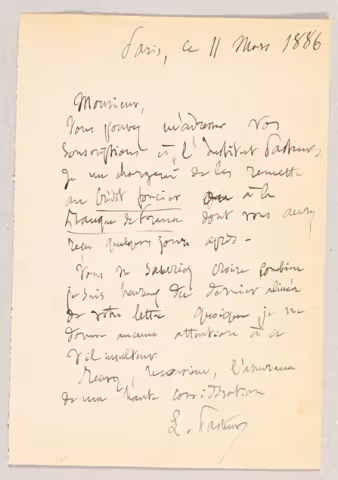
Transcript of the letter
Paris, ce 11 mars 1886
Monsieur,
Vous pouvez m’adresser vos souscriptions à « l’Institut Pasteur ».
Je me chargerai de les remettre au Crédit Foncier ou à la Banque de France dont vous aurez reçu quelques jours après.
Vous ne sauriez croire combien je suis heureux du dernier alinéa de votre lettre quoique je ne donne aucune attention à ce vil insulteur.
Recevez, Monsieur, l’assurance de ma haute considération.
L. Pasteur
Traduction :
Paris, 11 March 1886
Sir,
You may send your subscriptions to me, addressed to "the Institut Pasteur".
I shall undertake to deposit them with the Crédit Foncier or the Banque de France, from which you will have received [a receipt] a few days later.
You cannot imagine how pleased I am by the last paragraph of your letter, although I pay no heed whatsoever to that vile slanderer.
Please accept, Sir, the assurance of my highest consideration.
L. Pasteur
A letter capturing the moment
On 1 March 1886, Louis Pasteur presented to the Académie des sciences the results obtained in 350 patients and argued for the creation of a permanent vaccination centre. At that session, Louis Pasteur spoke these words:
It can be seen, on the basis of the most rigorous statistics, how great a number of people have already been saved from death. The prophylaxis of rabies after a bite is established. There are grounds for creating an establishment for vaccination against rabies.
As early as 8 March, a committee unanimously adopted the plan for an 'Institut Pasteur' and the principle of a public subscription. The letter acquired by the museum was written three days later, at the very moment the fundraising was getting under way.
It reads in part: 'You may send your subscriptions to me, addressed to "the Institut Pasteur". I shall undertake to deposit them with the Crédit Foncier or the Banque de France, from which you will have a receipt a few days later.' These few lines reveal just how rudimentary the administrative organisation of the collection still was at that stage: it was Louis Pasteur himself who received and forwarded the first donations. The mention of the Crédit Foncier and the Banque de France is no accident: their respective governors, Albert Christophle (1830–1904) and Pierre-Joseph Magnin (1824–1910), sat on the patronage committee set up by the Académie des sciences, and their institutions were to make significant contributions to the subscription: 40,000 francs from the Crédit Foncier and 12,000 francs from the Banque de France.
The letter also offers a glimpse of Pasteur's state of mind in the face of his detractors. He writes: 'You cannot imagine how pleased I am by the last paragraph of your letter, although I pay no heed whatsoever to that vile slanderer.' The remark echoes the violent attacks then being levelled at him by certain doctors and journalists, who accused him of charlatanism or of seeking profit — controversies that, paradoxically, would do nothing to dampen the popular momentum behind the subscription.
On 12 March 1886, the first meeting of the council and the general assembly of the Institut Pasteur was held. The question of how the collection was to be organised financially was already at the heart of the discussions. As early as page 3, one reads: 'M. Magnin says that the sums already paid in or still to be paid could be centralised at the Crédit Foncier, which would issue receipts and would let the Institute benefit from the modest interest it pays on sums deposited with it.' Pasteur's letter and this first set of minutes thus echo one another, allowing us to witness the very first steps of the fundraising campaign.
Looking back on a collective endeavour
The subscription that followed exceeded all expectations and grew into a movement of unprecedented scale. More than 100,000 donors contributed, their names published daily in the Journal officiel. Foreign sovereigns — Tsar Alexander III of Russia (1845–1894), with 40,000 roubles, Emperor Pedro II of Brazil (1825–1891) and Sultan Abdülhamid II of Turkey (1842–1918) — major philanthropists such as Madame Boucicaut (1816–1913) of the Bon Marché, with 250,000 francs, and the Rothschild family, with 56,000 francs, the French Parliament, with 200,000 francs, and humble citizens too — gendarmes, postmen, schoolchildren and young Joseph Meister himself, giving a few pennies: every class of society rallied to the cause.
Culture and the arts joined the movement: on 11 May 1886, a grand charity gala was held at the Palais du Trocadéro, with the participation of Alexandre Dumas, Charles Gounod and Camille Saint-Saëns.
In all, nearly 2.58 million gold francs were raised — the equivalent of one billion euros today! Thanks to these funds, an 11,000 m² plot of land was purchased on rue Dutot in March 1887, construction began in June of the same year, and the Institut Pasteur was officially inaugurated on 14 November 1888 by the President of the Republic, Sadi Carnot (1837–1894). Under a single roof stood a rabies treatment centre, a research institute for infectious diseases and a teaching centre.
An acquisition that enriches the memory of the Institut Pasteur
This letter joins the collections of the Pasteur Museum, whose holdings grow each year thanks to close monitoring of the auction market and to donations from private individuals.
Beyond its historical value, the letter is a reminder that the Institut Pasteur was born of an extraordinary surge of generosity, from donors great and small alike. It is a legacy that the Pasteurdon campaign, launched this week, seeks to carry forward, inviting people from all walks of life to support today's biomedical research in their turn.