Our key scientific outreach initiatives
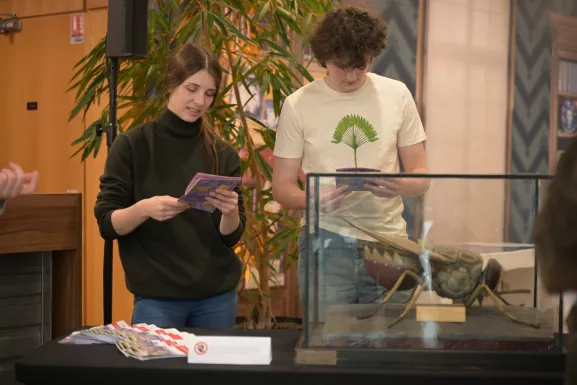
The Institut Pasteur, a committed partner in dialog between science and society
Ever since the Institut Pasteur opened its doors, we have been guided by the firm conviction that knowledge belongs to humanity.
Our commitment to scientific outreach as a core mission is now stronger than ever, with efforts to pass on knowledge, kindle curiosity, train critical thinkers, and build bridges between scientists and the public.
Forging direct links between scientists and the public
At the Institut Pasteur, dialog between the public and scientists takes numerous forms:
• lectures and meetings open to the public and public debates on key scientific and health issues;
• regular involvement in open scientific events such as Pint of Science, Utopiales and Brain Awareness Week.
• our open days: during the Pasteurdon event, we invite visitors old and young to come and explore our laboratories, take part in activities and talk to our scientists!
Superpowers of the Microbiota, Secrets of Smell, What Do Babies Think About?
See more
Outreach programs for all comers
The Institut Pasteur runs a wide range of outreach initiatives to cater for the needs and expectations of very different audiences.
For young people and school students
We are particularly keen to imbue young people with scientific culture through various hands-on experiences:
• the Young Researchers program, a flagship initiative allowing middle and high school students to conduct a live scientific project in a laboratory over a period of several months;
• job shadowing ("Collège 3" program) providing students with an insider's view of the world of research;
• laboratory visits, allowing young people to find out exactly what scientists do in their everyday working lives.
Initiatives to improve female representation in science
In collaboration with the Rêv’Elles association, the Institut Pasteur also holds awareness-raising events on campus. The Rêv'Elles association offers innovative career guidance programs for girls from working-class backgrounds. Since 2020, the Institut Pasteur has been welcoming large groups of girls onto campus every year to introduce them to a diverse range of jobs and professions.
For the public
The Institut Pasteur also plays an active role in major cultural and scientific events including:
• European Heritage Days;
• the French National Festival of Science;
• Nuit Blanche;
• science festivals (Double Science, Brain Awareness Week, etc.);
• UniStem Day, Europe's biggest scientific dissemination and outreach event on stem cells.
Pasteurdon: your invitation to the world of research
In the same spirit of sharing and interaction, we regularly open our doors to the public, particularly during the Pasteurdon event.
In 2025, close to 1,000 visitors, many of whom were children, visited our laboratories, took part in outreach activities, and talked to our scientists!
Throughout the world
We also pursue our scientific outreach work online:
• open access to educational videos;
• educational and informative content on social media – follow us!
Art & Science: exploring new forms of interaction between science and culture
We also encourage schemes that combine science, art and culture to inspire new ways of depicting research and reaching unexpected audiences.
Our Art & Science initiative explores creative crossovers between artistic and scientific thinking. One example of this work is the Organoid project in which artists and scientists get together to discuss biological breakthroughs and create inspiring and evocative visual representations of research discoveries and biomedical concepts.
Major works displayed on campus include:
• Sans gêne by Fabrice Hyber, an 18-meter high ceramic fresco that pays tribute to the Institut Pasteur's scientific research;
• Giant Monkey by Françoise Petrovitch, a work representing an African green monkey produced after the artist met Michaela Müller-Trutwin, a scientist working on HIV;
• L’œil du microscope by Miguel Chevalier, a 25-minute video about the various visualization techniques used at the Institut Pasteur;
• Vaincre le virus by Barthélémy Toguo, a 2-meter ceramic vase representing water, an element that is pure and regenerative but can also be a source of danger when polluted or contaminated;
• Inventaire by Aristide Barraud, a mural making the invisible visible by painting viruses and microbes in colors used by Louis Pasteur in his pastel drawings.
By working closely with creative professionals and organizing cultural events, we are putting science at the heart of human culture. We also work with art and design schools to constantly reinvent our scientific outreach formats.