History

The history of the Institut Pasteur: from Louis Pasteur to global scientific excellence
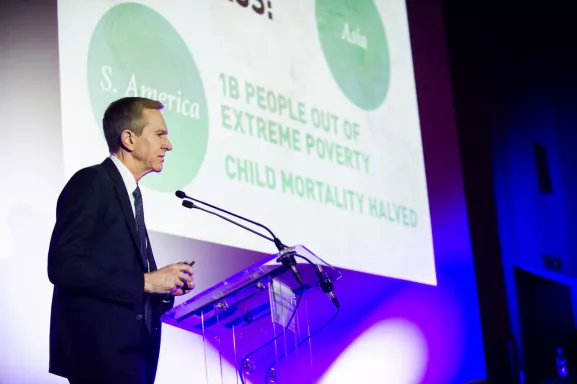
The Institut Pasteur, a non-profit foundation with recognized charitable status, has embodied French excellence in medical research for almost 140 years.
Built on Louis Pasteur's visionary work, the Institut Pasteur quickly made its mark as a global leader for people-centered life science and public health research.
For almost 140 years, it has consistently sought to understand, protect and innovate in the interests of human health.
Three key takeaways:
- 1 An institution that emerged from a medical emergency The rabies vaccine administered to the boy Joseph Meister in July 1885 proved a resounding success, triggering an influx of patients from across the world which raised the need for a dedicated institution. In 1887, a public appeal and a decree recognizing charitable status laid the administrative foundations for the Institut Pasteur, which officially opened on November 14, 1888.
- 2 A pedigree of 10 Nobel Laureates Scientists such as Ilya Mechnikov, Alphonse Laveran, François Jacob, Jacques Monod and André Lwoff have placed the Institut Pasteur firmly among the ranks of the world's most prestigious biomedical research institutions.
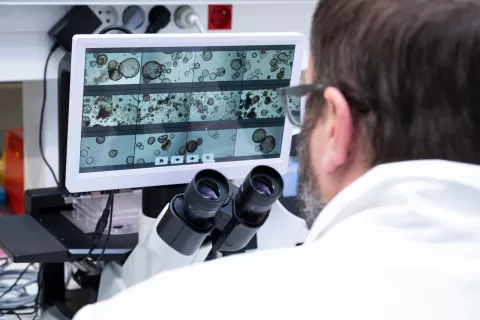
- 3 A forward-looking institute Our founding ambition of protecting each and everyone's health is now played out using state-of-the-art technologies (algorithms, state-of-the-art microscopy, artificial intelligence) to prepare our response for future disease outbreaks.
Who was Louis Pasteur and how did the Institut Pasteur come about?
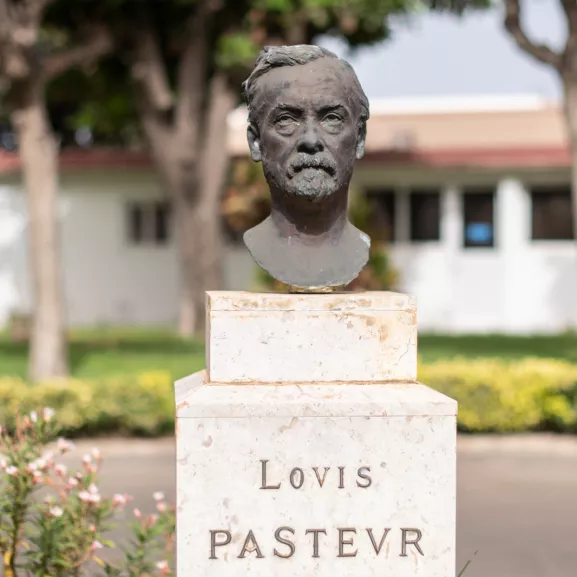
The origins: a visionary chemist's venture...
In the spring of 1880, a man examined the dried spinal cord of a rabies-infected rabbit in the depths of a gas-lit laboratory. With a graying mustache but a sparkle in his eye, Louis Pasteur had decided to defeat rabies, the "invisible dragon" that was causing so much devastation at the time.
His previous work on fermentation and pasteurization had taught him that microbes were secretly writing the history of the living world. This chemist by training went on to spark one of the 19th century's most incredible scientific revolutions. His scientific genius, boldness and concern for the most vulnerable members of society formed the basis of a research model that remains hardwired in the Institut Pasteur's DNA to this day.
You don't ask someone who is suffering, 'What country are you from?' or 'What region are you from?' You tell them: 'It's enough that you are suffering – you're in my hands and I will ease that suffering.

On the morning of July 6, 1885, Joseph Meister, a nine-year-old boy from Alsace, who had been bitten fourteen times by a rabid dog, came to Louis Pasteur's laboratory at the École Normale Supérieure. Over the next ten days, the child received thirteen injections of a progressively more virulent rabid spinal cord preparation. Joseph Meister never developed the disease and became the first human to be vaccinated against rabies.
Faced with a fresh influx of patients with animal bites from France and abroad, Louis Pasteur decided to set up a dedicated rabies vaccination center.
A legacy that includes 10 Nobel Prizes, milestone discoveries and the rise of a global network
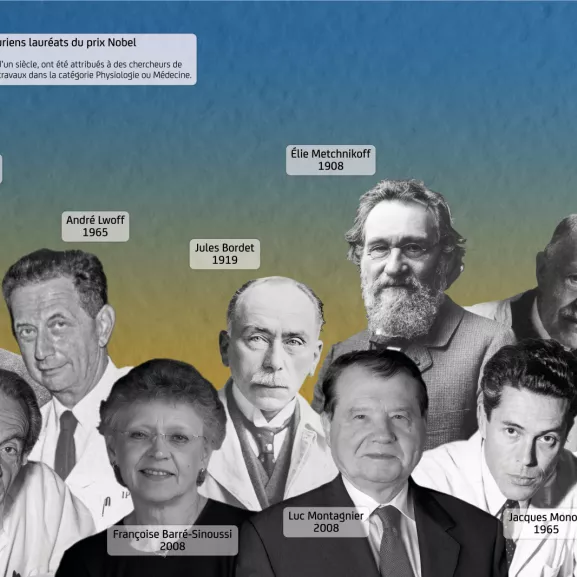
Since the Institut Pasteur was founded, 10 of its scientists have been awarded Nobel Prizes, testament to work that has fundamentally advanced our understanding of life and diseases.
Louis Pasteur's vision and scientific ambition quickly expanded beyond French borders. In 1891, his protégé Albert Calmette founded the first Institut Pasteur outside France in Saigon with the aim of expanding rabies and smallpox vaccinations in Indochina. This founding act marked the beginning of a gradual and resolutely international expansion.


Why the Institut Pasteur's mission continues to serve the public interest
Over 130 years later, the Institut Pasteur's vision remains unchanged. We are preparing our response for future outbreaks armed with algorithms and microscopes, but more than that, an unfaltering faith in our human-centered approach, whereby we treat first, question constantly and share unrestrictedly. Knowledge belongs to humanity, and science serves society best when it is freely shared, rigorously verified and conducted with the utmost integrity.